


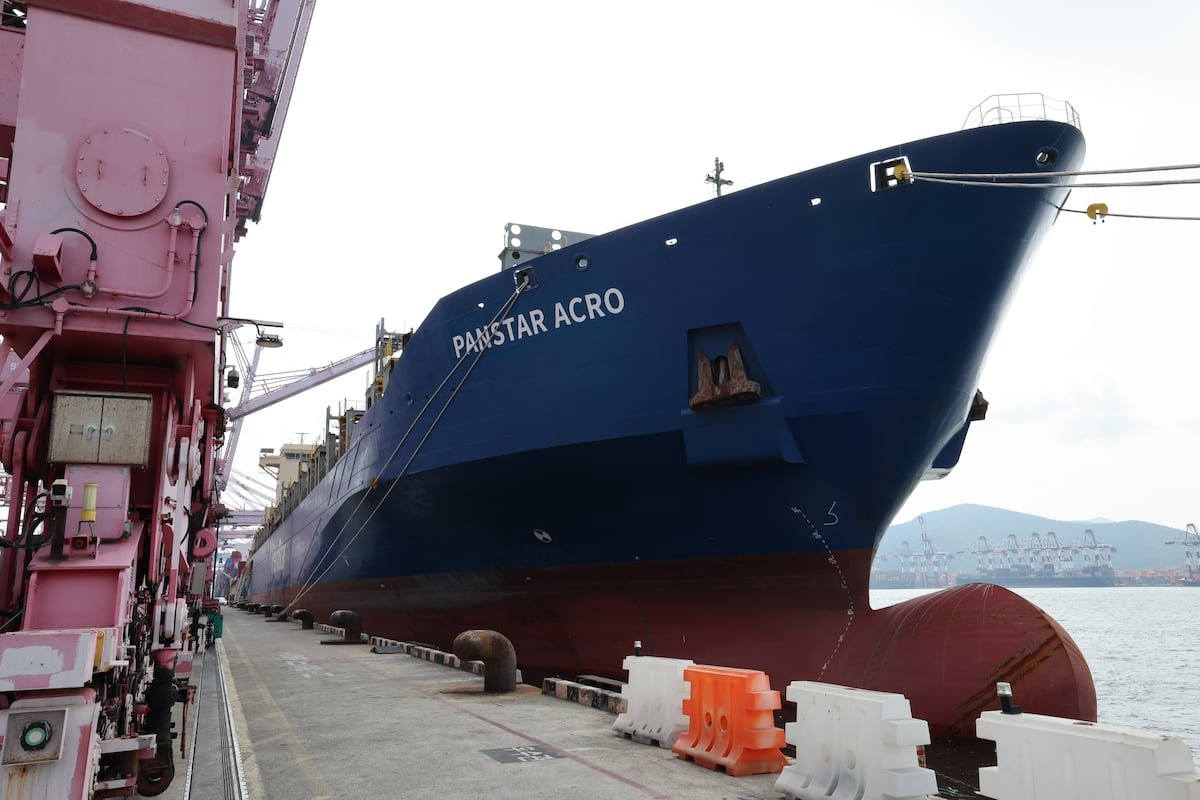
On August 26 and August 29, in the bustling port cities of Qingdao and Busan, located in China and South Korea respectively, two medium-sized cargo ships cast off. The Dubai Tower and the PanStar Acro headed for the British ports of Teesport and Felixstowe via the Arctic, before sailing to other destinations in Northern Europe.
This significant double move in the ever-frenetic world of maritime trade is redrawing the economic and geopolitical map. It shifts power and influence toward the Northern Hemisphere, at the expense of the Southern Hemisphere, and it grants yet another dangerous advantage to Vladimir Putin’s Russia.
Regular connections between Asia and Europe via the North Pole were unimaginable just a couple of decades ago. Even though global warming was already wreaking havoc back then, ice still covered the bulk of the Barents Sea. Today, however, the Chinese company Sea Legend intends for the new link between Asia and Europe to result in a weekly route. Its South Korean counterpart, meanwhile, is still in the testing phase.
The shipping sector estimates that navigability in the area will last around three or four months each year, from August to October (although there’s the possibility of an extension toward the end of that period). This means that a new route is now viable, one that drastically brings down shipping times when compared to the most-used alternative to connect Asia and Europe — the one that crosses the Suez Canal — and reduces them exponentially when compared to the route that crosses the Indian Ocean and rounds the Cape of Good Hope, at the southern tip of Africa.
“If the 20th century was the century of the Strait of Malacca, the 21st century will be the century of the Bering Strait,” predicts Arancha González Laya, dean of the Paris School of International Affairs at Sciences Po, in her recently published book, Solos en el Mundo (Alone in the World). “One of the greatest reconfigurations of global logistics has begun,” Spain’s former foreign minister adds.
With the Red Sea, the gateway to the Suez Canal, under constant Houthi pressure and the Strait of Hormuz doubly blocked by the U.S.-Israeli conflict with Iran, the situation could not be more favorable for the so-called Northern Sea Route. It shortens transit times by up to 40%, according to Kjell Stokvik, managing director of the Center for High North Logistics. And, he adds, this figure“will be reduced even further in the future, with transpolar routes.”
The Northern Sea Route allows for greater ship turnover. It reduces fuel consumption — which is crucial in times of scarcity — and it avoids the risk of armed attacks. Additionally, even though the premiums demanded by insurers are high, these have also grown significantly in Middle Eastern waters, which will level the playing field between the two routes.
However, there are significant drawbacks to this new route. The first is the environmental damage: if this route is feasible today, it’s precisely because of the unchecked advance of ocean warming and the continuous melting of the Arctic Circle. Nowadays, icebreakers are only needed in the final stretch of the season, well into October. And, despite the ships’ lower fossil fuel consumption on a shorter journey, the opening of this new route could exacerbate pollution. It could also further damage the biodiversity in a unique region, one that’s a natural sanctuary of incalculable value.
“These cargo ships risk collisions with mammals and other species in an area that also depends heavily on fishing,” notes Javier Arnaut, a professor at the University of Greenland-Ilisimatusarfik.
Anjali V. Bhatt, a research fellow at the Peterson Institute for International Economics (PIIE), points to a second challenge: the control that Russia exerts over the route. If Iran (and now the U.S.) wants to seize control of the Strait of Hormuz, charging tolls at will, it’s Rosatom — the Kremlin-owned nuclear corporation — that issues navigation permits in the far north. Naturally, this generates larger and larger sums of money for the Russian government, at a time of pressing economic need in Moscow. The opposite is true in Egypt: if the Arctic route becomes established, it will represent a financial drain on the already-strained coffers of the North African country, which are heavily dependent on ships transiting through the Suez Canal.
“From Shanghai northward, any ship taking the Arctic route reaches Europe faster [than via the Suez Canal]. But there will always be a drawback: there are no points where ships can make intermediate stops,” explains Jordi Torrent, a consultant and secretary general of the MEDPorts Association. “From Asia to Algeciras [in Spain], ships can call at four or five ports [including Singapore, Dubai, Egypt, Malta]. In contrast, there’s nothing when you pass through the Arctic, and that’s a structural limitation.”
Spain has benefited from the diversions around the Cape of Good Hope, reinforcing its role as a gateway to Europe via the Strait of Gibraltar, one of the few remaining open shipping lanes. The cities of Valencia and Barcelona have seen their business boom, while Algeciras has established itself as a critical port on a global scale. The Arctic route could diminish this influence.
Although there’s still no regular service, a total of 103 transits (outbound or return journey) were recorded last year via the Arctic route. That’s six more than in 2024 and 60 more than in 2022, according to figures from the Center for High North Logistics, based in Kirkenes, Norway. Most of these vessels were Russian and Chinese. Those numbers, however, still pale in comparison to the more than 24,000 ships that passed through the Suez Canal in 2024, the last year before the war in the Middle East reached its peak.
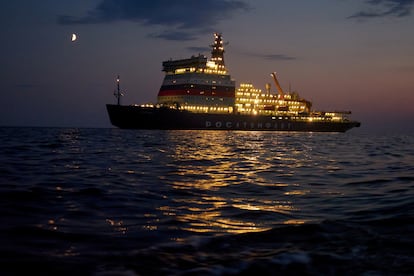
Neither North America nor Europe remains untouched by these commercial shifts (as well as military and energy-related ones) in an Arctic that has become one of the world’s hottest flashpoints in terms of clashes between global powers. The Trump administration has combined repeated annexation threats against Greenland with the announcement of a major purchase of Finnish-built icebreakers, bringing its fleet to over 50. Canada, not wanting to be left behind, has just announced the construction of six more of these vessels.
“The opening of these routes is generating anxiety in the U.S. to use the other Arctic route, the Northwest Passage, which Greenland has the rights to,” Arnaut explains. “It increases the value [of the island that’s under Danish sovereignty] for Trump and demonstrates that the gradual commercialization of the Arctic goes far beyond monetary value: it has strategic value.”
Meanwhile, in the next few weeks, the European Union is preparing to unveil the main points of its Arctic strategy for the coming years. It holds a strong hand: the continent has the advantage of geographical proximity, while Finland, Denmark and Sweden have historical hegemony in the area. But, as in so many other areas, many argue that it lacks ambition, that its instinctive caution risks holding it back at a time when the major powers, from Russia and the United States to China, are baring their teeth.
Summit in Lapland
Aware of the urgency, Helsinki (perhaps the EU capital with the most influence in a region where its future is at stake) has convened a high-level summit, to be held on September 13 and 14 in Rovaniemi, a town in Lapland, the northernmost region of Finland. “The Arctic region is an increasingly important part of Europe’s security environment. The European Union has direct interests in its stability, security and sustainable development,” said Finnish Prime Minister Petteri Orpo, while extending an invitation to several EU leaders.
“Europe’s challenge isn’t a lack of involvement. Rather, it’s about ensuring greater coordination and a clearer strategic direction,” Stokvik argues, from the Center for High North Logistics.
Michael Bravo, from the Scott Polar Research Institute at the University of Cambridge, also believes that the 27 member states can “benefit from these advances [in Arctic navigation].” The EU, he says, “has both the opportunity and the capacity to contribute constructively to shaping the region’s future, ensuring adequate environmental protection and economic stability.”
However, Alla Pozdnakova, from the Scandinavian Institute of Maritime Law at the University of Oslo, is more skeptical. “It’s fascinating to see China and South Korea’s plans, but I doubt these routes will have positive implications under the current circumstances, either for Arctic states or for the rest of Europe.”
On the contrary, she writes to EL PAÍS in an email, “Geopolitical tensions are likely to increase. And Arctic coastal countries, like Norway, will be exposed to greater risks of polluting accidents in the harsh conditions of Arctic waters. The ecological damage that a container ship accident can cause to the marine environment is enormous.”
Moscow’s leverage
“Russia not only uses natural gas to exert pressure on Europe, it can also use the Arctic as leverage: it can raise or lower the fees it charges shipping companies to transit the route, and it has the ability to shut it down whenever it chooses, much as Iran can with the Strait of Hormuz,” Vasco Sánchez Rodrigues, an associate professor at Cardiff University, warns by phone.
He also stresses the importance of the route as an outlet for Russian oil and gas exports, as well as a regular corridor for the movement of troops and military equipment to and from the Eurasian power.
In the words of Carlos Santana, director of IE University’s Advanced Supply Chain Management Programme in Madrid, the shift represents “a changing of the guard,” with a new lord and master of shipping routes. And it means more power for Moscow and Beijing. “For China,” he notes, “the Arctic isn’t just a potentially shorter route; it is, above all, a new strategic option.”
And for the Kremlin, concludes Torrent, the Arctic has been an obsession for four centuries. “Russia’s only maritime outlets were through the Black Sea, controlled by Turkey, and the Baltic. That is why access to the Arctic was one of Putin’s five priorities for this century. Thanks to climate change, that goal has now been achieved.”
Sign up for our weekly newsletter to get more English-language news coverage from EL PAÍS USA Edition