


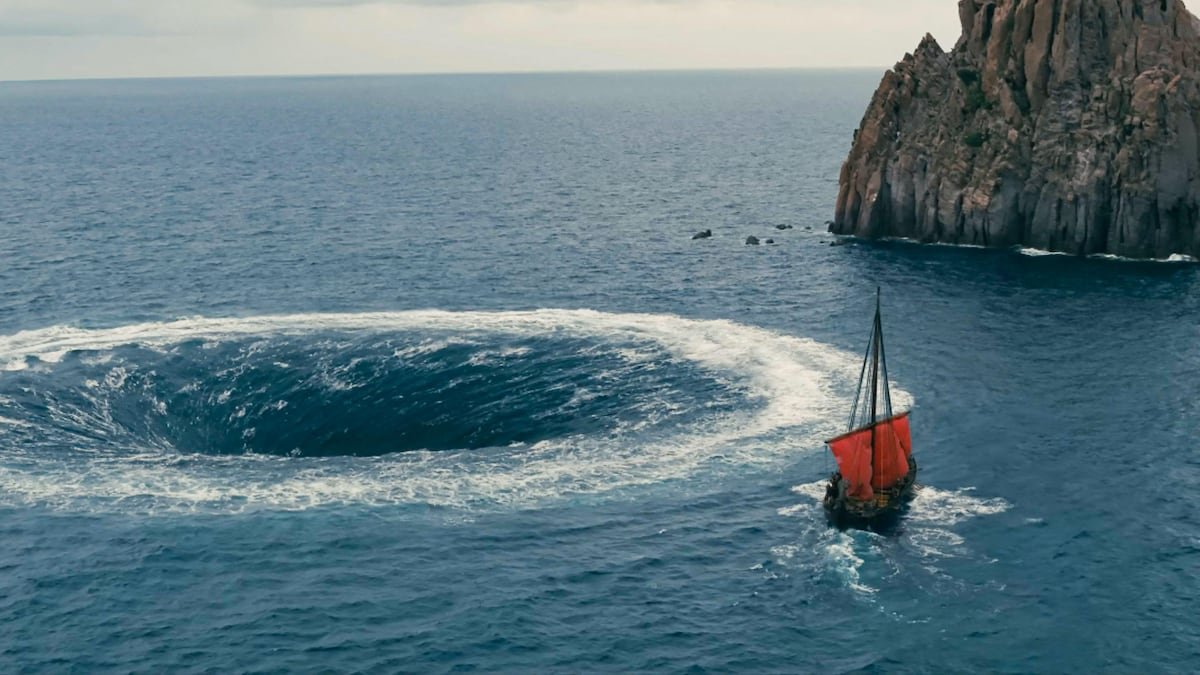
Legend has it that the painter William Turner — born in London in 1775 and obsessed with depicting the fury of the sea — had himself tied to the mast of the Ariel (a small sail-and-steam vessel) during a harrowing storm that lasted several hours, an ordeal he would turn into his famous painting Snow Storm (1842). Art historians such as James Hall debunk this anecdote, which nonetheless echoes the stories circulating online about the filming of Christopher Nolan’s The Odyssey. In fact, Instagram is full of reels about the difficulty of mounting heavy IMAX cameras on the unstable boats used in the film (the main one is actually a replica of a Viking ship) and some actors recall that motion-sickness pills ran out during the shooting of the shipwreck scene on the island of Ogigia, where Calypso (Charlize Theron) detains Odysseus (Matt Damon) after his crew’s death. Again, Nolan’s aim was to capture the sea’s wrath with the highest level of detail and realism, exposing his crew to actual storms.
Although — according to the tourist and summer imagery that emerged in the mid-19th century and spread widely throughout the 20th century — the sea is associated with pleasure and vacations and has become the serene protagonist of the most picturesque postcards, this narrative (and the uses of the coast associated with it) still coexists with that of the workers for whom the sea is a means of livelihood. But above all, it clashes with the idea that painting and literature had disseminated in the past, especially during the Romantic era. The shipwreck was modernity’s favorite accident, the subject of countless paintings that depicted “the boundless ocean set into a rage,” as Immanuel Kant wrote in his Observations on the Feeling of the Beautiful and Sublime (1764). The “maritime sublime,” fraught with threats, served to highlight the distinction between nature (unruly) and man (insignificant) and permeated 19th-century culture, becoming the major theme of both the novel (The Narrative of Arthur Gordon Pym of Nantucket, Moby-Dick, etc.) and painting (Vernet, Géricault, Turner, Delacroix, etc.). With whaling ships and explorers in full swing, shipwrecks were a major topic of public conversation because — in addition to projecting their allegorical power, as sea travel became more widespread — this fate befell a growing number of Europeans: Percy Shelley drowned in the Tyrrhenian Sea in 1822, and by about 1850 almost every well to-do British family had lost someone to the waves.
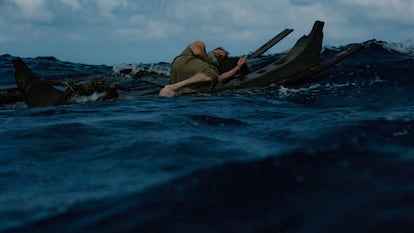
If in old shipwreck paintings nature — like the fury of the ancient gods — dismantled rigging and shattered planks, condemning sailors to drown among the shoals, from 1900 onward large steel ships nearly immune to such vicissitudes could be built thanks to engines and, shortly after, to new welding techniques. In 1912, the Titanic, presented by the press as unsinkable, was an exception whose fate the Russian poet Alexander Blok celebrated, saying that its misfortune had made him “indescribably happy” because it showed that “despite everything, there is still an ocean.” After that last great trauma, following two world wars and in the full atomic age, shipwreck lost its Promethean meaning.
Today, as climate change or AI pose more tangible threats, shipwrecks reappear time and again as the subject of novels, auteur films, blockbusters and even the work of contemporary artists such as Ai Weiwei or Juan Uslé. On one hand, they are accidents that, sadly, still occur and are today closely linked to refugee movements. On the other, shipwrecks continue to function as a powerful metaphor used in fiction to explore many issues that go beyond navigation or survival.
The appeal of a universal theme
“The theme of shipwreck is so broad that it extends to the most diverse crises of individual or collective experience. The sea, by virtue of its liquid condition and the perpetual motion of its waves, is the mediator between the formless (air, gases) and the formed (land, solid) and, analogously, between life and death,” writes art historian Esperanza Guillén in Naufragios (Shipwrecks, Siruela, 2004). In this short essay, the professor examines the prominence of shipwreck in the collective consciousness until it wanes toward the late 19th century and links it to Kant’s notion of the “dynamic sublime.” For the philosopher, this category included “storm clouds gathering in the atmosphere amid lightning and thunder, volcanoes unleashing all their destructive power, hurricanes leaving devastation in their wake, the immense ocean agitated by a storm, the cataract of a great river, etc.” In a way, Kant anticipated the thrill felt by viewers of disaster films by 200 years, noting that this vision “has the more appeal the more terrible it is, since we find ourselves safe.”
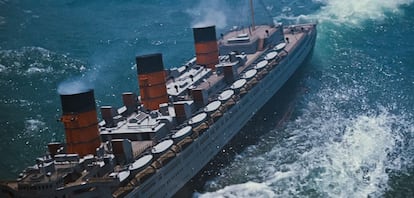
Shipwrecks have never left the movie screen. If The Poseidon Adventure (1972) and Titanic (1997) broke box-office records, films in which a ship goes down and its crew must survive continue to be made, as do documentaries that reconstruct real incidents: Shipwrecked: Nightmare at Sea, about the Costa Concordia cruise liner sinking in 2012, was one of the most watched titles on Netflix during July 2026. In The Square (Ruben Östlund, 2017) the shipwreck is the catalyst that exposes the characters’ contradictions. After all, as Hans Blumenberg explained in his book Shipwreck with spectator (1978), the sea voyage model is one of the most persistent across cultures because it includes departure, the port, the storm, the calm and, fundamentally, the shipwreck. In other words, an ideal existential metaphor.
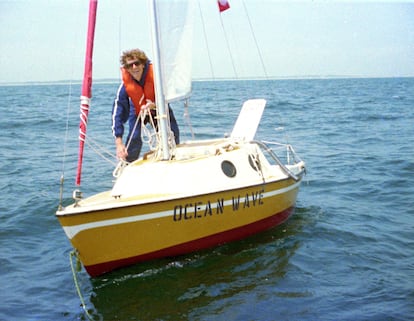
In the art world, some have even, unwillingly, inverted the metaphor’s operation, confusing reality and imagination in their work. The best-known example is artist and performer Bas Jan Ader, who had been experimenting with the concept of failure or disappearance (his falls from a bicycle into Amsterdam’s canals became famous) when he attempted to cross the Atlantic without experience aboard a tiny sailboat. When his vessel was found adrift between Ireland and the Azores in April 1976, no one took it too seriously. For months the possibility of an accident was ruled out and people waited for the artist to reappear before the public, completing a supposed performance that had turned into a true disappearance.
A contemporary accident
“Down in the cabin, water was already coming up through the floorboards. How long had they wasted up on deck, staring at the whale!” The first chapter of A Marriage at Sea (Riverhead, 2025), by Sophie Elmirst, recreates the collision with a sperm whale and the sinking of the yacht on which the Baileys were crossing the Pacific. The author, who recounts in her book the real ordeal of this couple and was interviewed in EL PAÍS by Jacinto Antón, says she was less interested in the technical or spectacular details of survival on a liferaft than in the psychological dimension of an event that would push any relationship to its limits: “Setting off to sail around the world together on your yacht, with no radio, is already risky and a trial by fire if everything goes well, but if you add shipwreck to the mix, you have a very extreme version of marital crisis. They discover things about each other they didn’t know, engage in recurring conversations, argue with no possibility of getting up and leaving.” Curiously, the Baileys’ problems resemble those of any married couple on land… albeit adrift and surviving by catching turtles with safety pins.
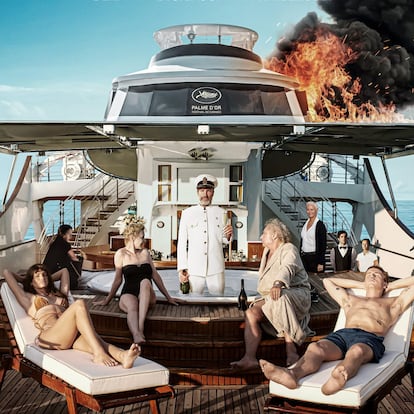
Another real shipwreck, that of the Bayesian (a large yacht that sank off the coast of Sicily in August 2024, causing the death of its owner, millionaire Mike Lynch, and six others) also promises to generate much literature. In The Beauty of the Accident (AKAL, 2025), philosopher and mathematician Javier Moreno uses it to warn that errors can even affect those who built their fortunes on uncertainty: “Mike Lynch, a mathematician, made his fortune creating, buying, and selling AI companies that use Bayesian inference, a probabilistic tool used in pattern recognition, to model uncertainty or in recommendation systems; hence the curious name of the boat. The sinking of the Bayesian strikes us as one of those moments when the randomness of nature seems to want to teach us something.”
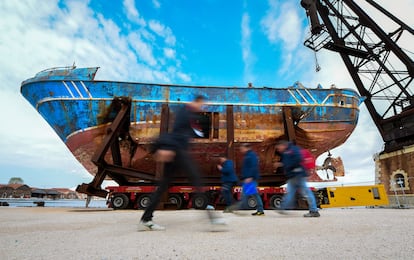
Unfortunately, the lesson of Barca Nostra, the work by Christoph Büchel shown at the 2019 Venice Biennale, remains relevant. The artwork is actually the recovered hull of a vessel whose shipwreck — the deadliest recorded in the Mediterranean— cost the lives of hundreds of migrants in 2015 off the island of Lampedusa. Displaying it as an installation stripped — by its literalness — any meaning beyond protest. Presented as an art installation, its literal nature stripped away any meaning beyond protest. For while a shipwreck is an unbeatable metaphor, present throughout our artistic and literary tradition, it is first and foremost a tragedy that remains all too close to home.
Sign up for our weekly newsletter to get more English-language news coverage from EL PAÍS USA Edition