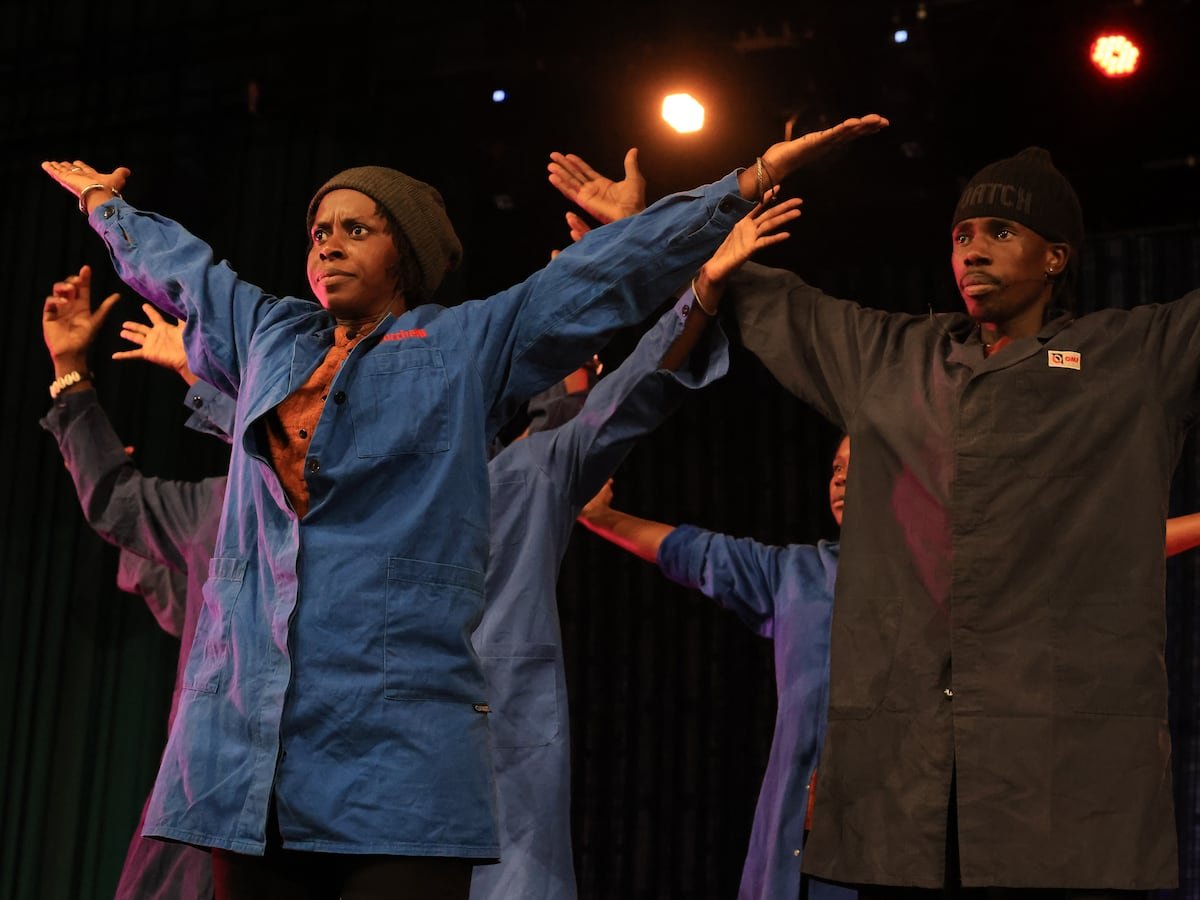
Against the backdrop of Abidjan’s skyscrapers, the magnetic rhythm of zouglou fills the air. Two dancers weave multi-rhythmic choreography on stage, the brilliant voices of three women accompany the singer, and the percussion sets your heartbeat. Spotlights, grilled fish, fried plantains, and the reflections of the lights on the Ébrié Lagoon, which borders Ivory Coast’s economic capital, complete the spectacle at one of the nights of the 14th edition of the Abidjan African Performing Arts Market (MASA), a biennial event that has attracted more than 570,000 visitors and this year broke records with the presence of 320 programmers from 72 countries; in 2024, there were 115 from 40 countries.
Attendees spent the week of April 11-18 moving between stages and city squares to connect with the industry and experience the scope of an overwhelming program of 300 works from more than 120 companies in 51 countries, 29 of them from Africa. “It’s amazing to see so many professionals and artists from across the continent here,” said Christine Semba, representative of the Womex international music fair.
Musicologist and manager Silvia Guevara is also fascinated by this edition, having attended the first MASA in 1993. “It was much smaller, and now, more than 30 years later, you can see how it has adapted to new trends. There’s innovation and freshness here, and you won’t find that anywhere else in the world,” said the former representative of the Puerto Rican band Calle 13 in Europe. “The most interesting electronic music of recent years has come from Africa,” adds Semba.
“I’ve seen several pieces that could work very well in Edinburgh. This has exceeded my expectations,” said Elliot Comnene, programmer of the Assembly Festival, one of the most prestigious venues at the Scottish capital’s Fringe Festival. He explained it’s his first time in Africa and that he was focused on theater, dance, comedy and circus, which are four of the seven disciplines along with music, puppetry and slam (poetry recital) that make up MASA, whose organization facilitated the coverage of this report.
Harold David, deputy director of the Avignon Off Festival, is also seeking theater with the aim of increasing Africa’s presence at this event, which runs parallel to the official program in the French city. “This is my first time at MASA, and I’ve come because Africa and contemporary African creation are completely absent from the program. We have 1,900 performances, and I think last year there was only one from Senegal and another from Morocco. We have participants from 180 countries, and we are Francophone, like so many countries in Africa. The program needs to change,” he stated emphatically. Viviana Akamine, cultural director for the Bolivian city of Santa Cruz de la Sierra, where a major international theater festival is held, agrees with this observation. “I’ve come to discover the talent here because it’s unknown at home, and we’re interested in seeing their work,” said the expert, who by the fourth day was already sporting elegant trousers with typical Bogolan prints.
“Everything is concentrated at MASA. I come here open to discovery,” said the veteran Slim Sanhaji, director of the Carthage Theatre Festival. He flew in from Tunisia and crossed paths with colleagues from Japan, Armenia, and Uruguay, but above all, there is a strong presence of programmers from Brazil, Burkina Faso, Canada, Spain, the United States, France, and Senegal. They all spend their days coordinating their schedules under the heat of these West African latitudes to get to what interests them most. Only on the 10 stages of the immense Palace of Culture, the vibrant heart of MASA, can you be mesmerized by the live performance of Malian rapper Ami Yerewolo, marvel at the acrobatics of Ivory Coast’s Ivory Circus Décalé, encounter a colorful street show by Circus Raj from India, or experience a profound and mischievous offering from La Huella Teatro, from Chile. All of this takes place simultaneously with workshops, conferences, business meetings, cameras filming for the MASATV channel, dozens of presentations at the Innovation Village, and what the streets already have to offer.
Everywhere you turn, there are artists rehearsing, kids recording videos of themselves dancing, hundreds of uniformed schoolchildren leaving class to attend children’s activities, and markets selling clothes, food, and instruments. In addition, there’s a citywide program at cultural institutions, community centers, and squares in more peripheral or disadvantaged neighborhoods. And all of it is free.
Artistic dissemination is one of MASA’s objectives, but its director, Abou Kamaté, also hopes that African cultural industries will be recognized as “full-fledged players” in the global creative economy. “We want Africa to be not just a source of talent, but a market, a stage, and a strategic partner.” Ivory Coast’s Minister of Culture and Francophonie Françoise Remark attended MASA daily. “This cultural movement reflects a very firm political will to support, structure, transform, and professionalize our sector. Talent alone is not enough; we can also invest in professional development, which is very important for young people,” stated the minister, who prioritizes girls’ education, women’s leadership, and the promotion of creative industries among young people in a country with 30 million inhabitants, 75% of whom are under 35.
“Youth is one of the president of the Republic’s main concerns, and particularly employability. And we know that the cultural sector can address this issue,” the minister emphasized, noting that one of his country’s companies is in talks to participate in the Almagro International Classical Theatre Festival. “What is generated at MASA, which is the largest market of its kind on the continent, is a cultural and economic ecosystem that benefits not only artists but also industry stakeholders. And this is important because knowledge is shared, creating a two-way benefit,” explains Ángela Rodríguez Perea, director of the Spanish Cultural Center in Bata, who participated in a roundtable discussion as a representative of the Spanish Agency for International Development Cooperation.
But among so many open paths, there’s a barrier hindering the dissemination of culture: visas for countries with less powerful passports. “They’re the biggest problem,” says Thierno Soumaré, production director of the Batuki Music Society in Toronto. “We book the artists, send the contracts, put them on the posters… and at the last minute they’re denied entry. And often the flights are incredibly expensive. This prevents our festivals from evolving.” Consequently, the public is disappointed, and uncertainty plagues the sector on several fronts. “It’s not fair to put these barriers up against professionals who want to showcase their work and generate income. If they have the guarantee of being able to travel and return home, they won’t want to stay illegally,” says Semba of Womex, who recounts that she was part of a working group that addressed these issues. “We’ve gone to talk to politicians to tell them that they’re not criminals, they’re professionals. And we compiled statistics in France that showed that only 1% stayed, so why put up so many walls?” she asks.
Adding to the visa policy issue is widespread protest over the lack of government support for the performing arts. “As long as our heads of state, our governments, do not consider art and culture as a sustainable development goal, we will continue going to the sea to feed the fish,” argued Hassane Kouyaté, director of the MASA international artistic committee and programmer in France, in a statement that was followed by applause from the audience. And the industry is pushing forward. “MASA confirms something we already knew: Africa doesn’t wait. It builds. At Wanaut, we handle ticket sales and event management with a plan for emerging markets. We are committed to South-South partnerships because we share the same vision and the same urgency,” says Sina Bouchareb, commercial director of the Moroccan company Wanaut, which promotes its project in several languages.
As the week drew to a close, all the activity at MASA seemed like a counterpoint to the geopolitical dynamic of violence that governs the planet, as if the script were written on the antipodes of borders. Here, choreographies are created using hands that exchange phone numbers, business cards, social media accounts… or raised arms to take photos, dance, or order food. The spotlights illuminate diversity, the search for historical connections, wordless dialogue, or shared emotions — whether in a syncopation or a dizzying leap. The leap that follows a powerful surge.
Sign up for our weekly newsletter to get more English-language news coverage from EL PAÍS USA Edition