

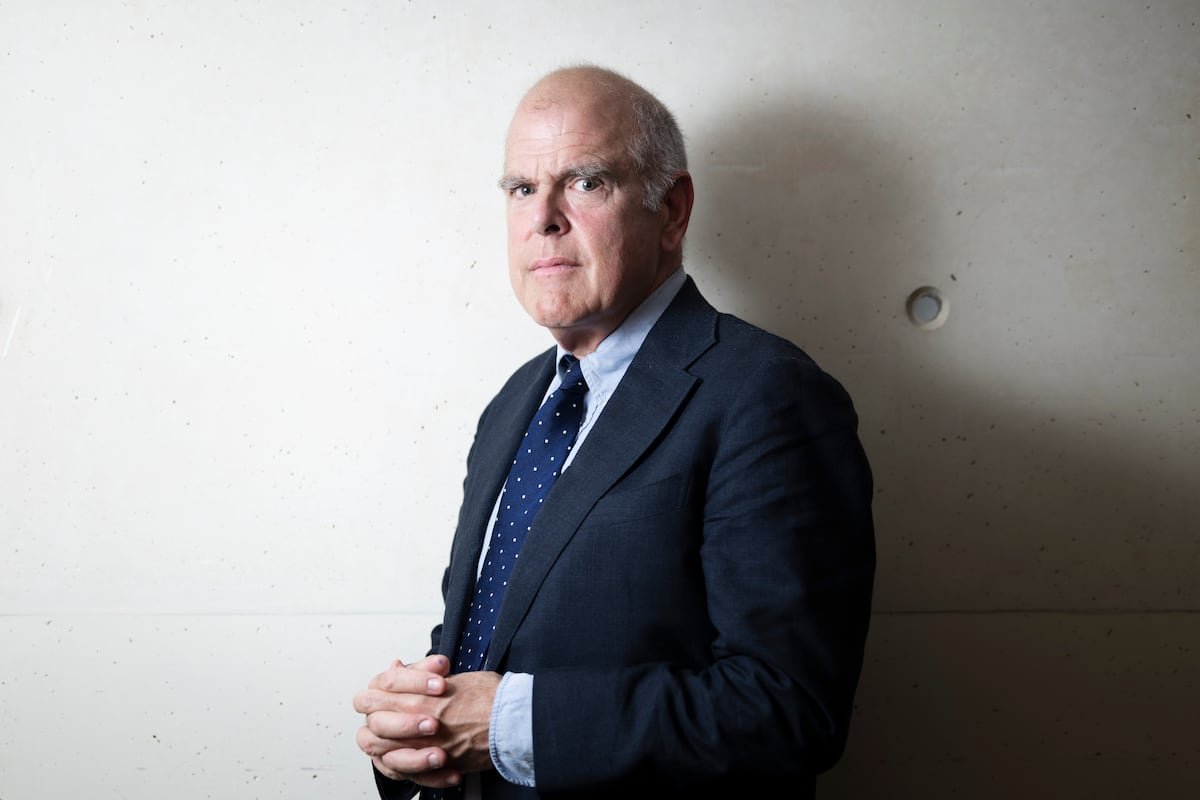
Christopher Caldwell, 64, is a veteran U.S. conservative political analyst. A leading writer for the now-defunct The Weekly Standard — something of a bible for Republicans until it shut down in 2018 — he is the author of books such as Reflections on the Revolution in Europe: Immigration, Islam and the West and The Age of Entitlement: America Since the Sixties. He is now a regular contributor to The New York Times Opinion section and has also been a columnist for the Financial Times.
Speaking in Spain during the annual meeting of the Cercle d’Economia in Barcelona, Caldwell discusses the increasingly complicated relationship between Donald Trump’s administration and its European allies. He also examines the domestic political impact of the war with Iran, which he sees as a watershed moment for the entire Trump era. The interview took place before the ceasefire was announced.
Question. You say the Iran war is the big turning point for Trump’s decline. Why?
Answer. It is for two reasons. First, his promise not to keep getting involved in distant wars was very important to his 2016 presidential campaign — it was how he introduced himself to the American people, and that mattered to many of his voters. He even described George W. Bush as a war criminal. The other problem is that people remember the George W. Bush administration and that after going to war with Iraq, the entire domestic agenda stalled. People think there are bigger problems [than Iran] in the United States.
Q. How do you think this could affect the House and Senate elections in November? The president’s party almost always loses ground in the midterms, but do you expect a stronger backlash than usual against Republican candidates as a result of Iran?
A. Every poll puts Republicans close to losing the House and increasingly close to losing the Senate as well, but given Trump’s falling popularity, it’s surprising the predictions aren’t worse. There will be a cost. Trump had very bad midterm results in 2018, as did Obama in 2010.
Q. In Europe, many people wonder what has happened to the Republican Party, the party of Abraham Lincoln.
A. There’s a lot of deep, structural changes in the United States. We’ve gone from being a manufacturing, mass-production economy to being an information economy: the economy has shifted from factories to laboratories and universities. In that economy, Democrats have become the party of the elite, and many who are left out of that network are voting for Trump. The thing that Europeans tend not to understand about Americans is that Americans see exactly the same Donald Trump that Europeans do — they are not blind to his flaws. Trump voters know he has a short attention span and they understand his corruption, particularly in his second term. But they have a different diagnosis of how serious these problems are — they see inequality and mass immigration as more serious. They are also deeply alarmed by cultural changes: they don’t like the trans movement; they don’t like surgeries on teenage girls to remove their breasts; they don’t like men in women’s sports. They take these issues very seriously and balance them against other priorities.
Q. Vice President JD Vance’s remarks about Europe at the Munich Conference a year ago were very hostile. This year, U.S. Secretary of State Marco Rubio was softer in tone, but not in substance. Do you think the Trump administration has a point when it criticizes Washington’s European allies?
A. I think Vance was misunderstood and that his goal was to build new bridges in Europe. I believe the Trump administration is more sympathetic to Europe than Europeans tend to think. Remember the context of that speech: Vance was expressing alarm about the elections in Romania, where a populist candidate [Călin Georgescu, who ultimately did not win] appeared to be winning, and his point was that the European Union was depriving the U.S. of allies in Europe. Europeans do not understand that the United States is very serious about wishing to continue the European alliance on the same terms, even if that’s not always apparent from the words of the president.
Q. Do you think Trump is justified in his complaints over trade?
A. Regarding trade, I think the argument that the United States has deindustrialized too much has won out — people believe something must be done to boost manufacturing capacity, and a traditional way to protect industry is tariffs, so people were willing to accept them. The problem is that they were imposed randomly at such strange rates that they don’t do any of the work of promoting re-industrialization.
Q. But German factories don’t seem to be to blame for U.S. deindustrialization.
A. No, but the idea is that a tariff creates a more favorable investment climate for the U.S. The issue is you also need a stable system, and we don’t have one. Still, the argument for protectionism has generally been accepted — for example, Biden kept Trump tariffs on China.
Q. Do you share the criticisms about NATO’s contribution?
A. Similar points can be made as with trade. The argument that NATO members should invest more in armaments has won — except in Spain, of course. And I think that argument found a receptive audience in Europe: even if they don’t say so, Europeans see this as a great opportunity to emancipate themselves from American tutelage, to be a bit more independent. So that argument has won. Nevertheless, demanding NATO countries enter a war that had been kept secret from them was preposterous, of course.
Q. You have called Trump erratic. He has also been described as populist, demagogic, authoritarian. How would you describe him?
A. I think populist is a good term. In modern U.S. politics, there are two poles — populists and elitists — and neither side usually uses that term to describe itself.
Q. Are you pessimistic about Trump’s legacy, not only in the United States but across Western countries?
A. I have worries, but I think the Trump interlude is likely to end because, simply, there aren’t that a lot of people like Trump. The populist parts of his program — the idea that people in rural and manufacturing America should be more included in the country — will stay. Trump’s difficulties come from his unpredictability, his changeability, his vanity, his corruption… That cannot last. We don’t have many other politicians like him, so he will either be replaced in government by a Democrat or by a very different kind of Republican.
Sign up for our weekly newsletter to get more English-language news coverage from EL PAÍS USA Edition