On May 5, 1789, King Louis XVI of France inaugurated the Estates-General. The institution convened that year to address the problem of rampant inflation and the bankruptcy of the monarchy, which was deeply indebted due to a lack of revenue. Neither the nobility nor the clergy paid taxes. Not because they were short of money. Their reason for exemption was simpler and more absurd: it was their privilege.
The privilege was closely linked to the discontent of 98% of French citizens who suffered from food shortages and rising prices and who were neither members of the nobility nor the clergy — the so-called Third Estate. This discontent stemmed not only from the injustice of taxes that disproportionately burdened those with the fewest resources, but also from the political power imbalance that these privileges revealed.
More recently, on June 8, 2021, ProPublica published an investigation into the taxes of U.S. billionaires. After accessing their tax records, they found in several annual returns of Jeff Bezos, Elon Musk, George Soros, and Warren Buffett that they had managed to pay absolutely no income tax without committing a single irregularity. They were the most notorious cases, but the average income tax rate paid by the 25 richest people in the country between 2014 and 2018 was also disconcerting: 15.8%. “That’s lower than the rate a single worker making $45,000 a year might pay,” ProPublica wrote. Although the difference is not as pronounced in Europe, the same rule applies in Belgium, Spain, Italy, France, and the Netherlands: the effective taxes paid by the wealthiest 1% are always lower than those of the average taxpayer.
Seen from today’s perspective, the privileges enjoyed by the pre-revolutionary Church and nobility seem almost trivial. Wasn’t it supposed that privileges reserved for certain social classes had ended centuries ago, precisely because of the progress achieved after the French Revolution? As Max Lawson, who leads Oxfam’s research on inequality, says, billionaires have minimized taxes and other regulations that limit their profits by using a series of tools that transform economic power into political power. Among the classic levers for achieving this are campaign and party funding, the threat of taking the money elsewhere, traditional lobbying, and the appropriation of public discourse through investments in media, social networks, and the hegemony of artificial intelligence.
While middle-class parents in parts of the Western world find it increasingly difficult for their children to match their standard of living, the world’s billionaires have acquired new superpowers to manipulate politics. Some examples? The power to decide a country’s military fate by granting or denying access to its satellites (Musk’s Starlink is one such example); the power to contribute to or not the spread of disinformation that threatens democratic coexistence (the cases of Facebook and X, for instance); or the power to revolutionize the world of work and communication with AI, while many countries struggle to pass even minimal regulation.
That their voices are heard more than everyone else’s wouldn’t be so problematic if their interests were aligned. But the short-term incentives of billionaires, whose wealth derives from capital gains, don’t usually coincide with those of the majority of the population, whose income depends on wages. Greater regulation of financial markets, for example, protects society from cyclical crises, but reduces billionaires’ opportunities to inflate their fortunes. There are also conflicting interests on sensitive issues such as the future of public healthcare and education.
According to economist Branko Milanovic, breaking the link between economic and political power is difficult because those who wield it know how essential that influence is to maintaining their position. “But a savvy plutocrat would do the same thing capitalists did after World War II: faced with the possibility of communism, they accepted many of the demands for equality in order to preserve their power,” he explains. “If the major plutocrats don’t curb their appetites, and their ambition becomes too obvious, the backlash against them could end up undermining the very pillars on which they stand,” he warns.
“There is likely no historical precedent for the wealth inequality that exists today, and indeed, there is no precedent for the level of global wealth,” Milanovic continues. In his opinion, two of the reasons why billionaires seem to continue accumulating wealth without qualms have to do with the “lack of recent precedents in which their power was challenged,” and with the visibility afforded by social media. “Before, the names of billionaires weren’t widely known; now they’re in the news every day, everyone recognizes them. I don’t know if that also makes it harder for them to curb their appetites.”
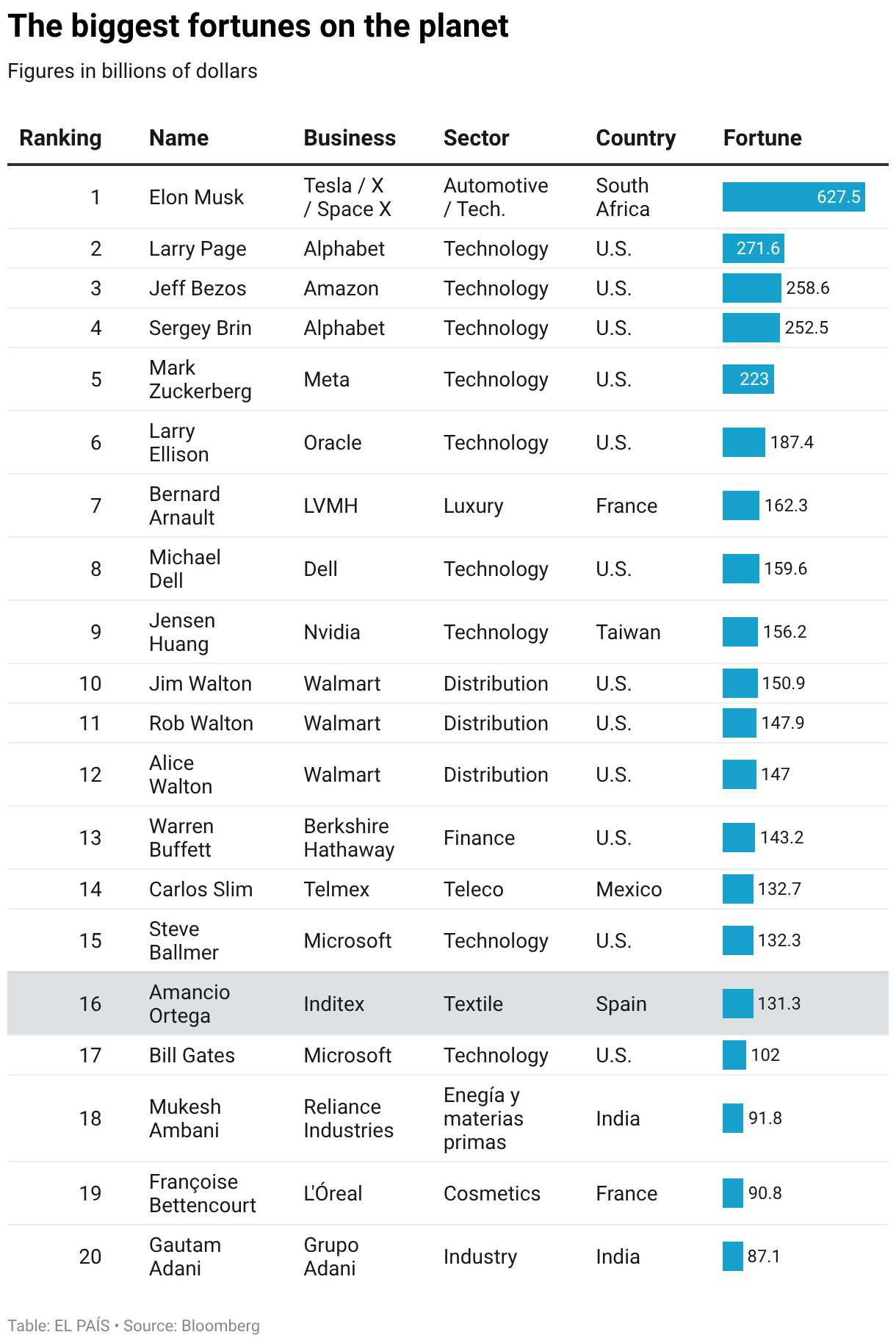
Throughout 2025, the fortunes of the world’s billionaires grew at three times the annual rate they had recorded on average over the previous five years. “Actions of the Trump presidency, including the championing of deregulation and undermining agreements to increase corporate taxation, have benefitted the richest,” according to an Oxfam report published in January.
Billionaires’ investments are further evidence of the transmission belt that transforms economic power into political power. In the 2024 U.S. elections, just 100 families contributed one $1 of every $6 spent by candidates, parties, and committees. They invested $2.6 billion that year, more than double the $1 billion they had invested during the 2020 elections, and 160 times what they invested before the U.S. Supreme Court eliminated limits on campaign financing in 2010. Something similar is happening with public discourse: more than half of the world’s leading media outlets are owned by billionaires, according to Oxfam’s calculations; eight of the 10 largest AI companies are run by billionaires, as are nine of the 10 largest social media platforms.
In December 2024, the journal of the National Academy of Sciences published research by Eli G. Rau and Susan Stokes on the pernicious effects of inequality: the likelihood of democratic backsliding was seven times greater in the most unequal countries, they concluded. According to Rebecca Gowland, who works in the U.K. as a spokesperson for Patriotic Millionaires (an organization of millionaires aware of the problem of inequality that campaigns for governments to raise their taxes), this backsliding ultimately delegitimizes the entire system.
“The problem is not only that billionaires are designing policies that affect us all to their own benefit, but that they are doing so in plain sight, and that also makes us lose faith in democracy,” she says. Billionaires themselves admit this in anonymous surveys. “In the last survey we conducted in January in the G-20 countries, we asked them if they believed that extreme wealth was used to buy political influence, and almost 80% responded that it was and that it shouldn’t be,” she explains.
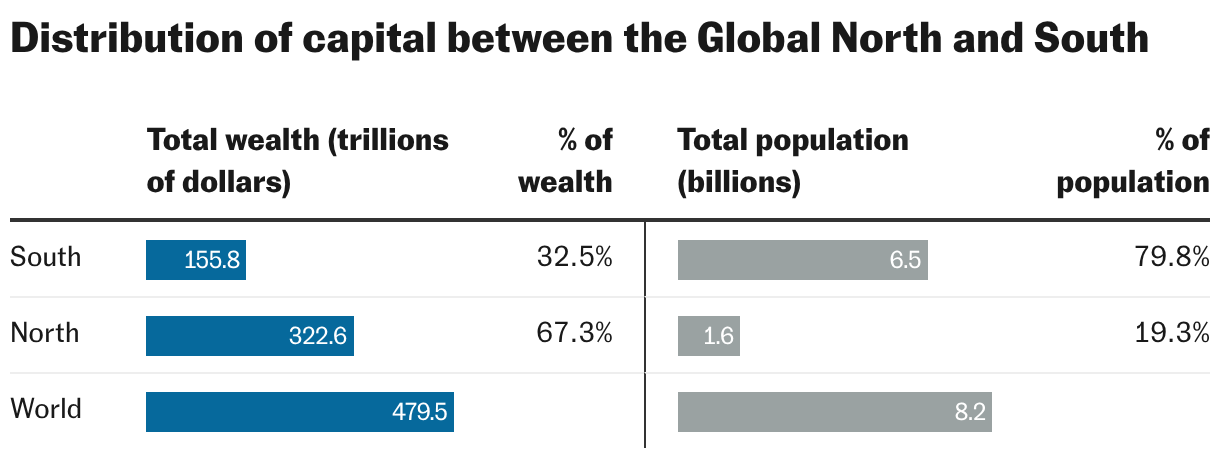
According to the latest Oxfam data, the world’s 12 richest people collectively possess more wealth than over four billion people. The growth of billionaires’ fortunes is not solely due to the fact that taxes have little impact on their wealth. According to Francisco Ferreira, head of inequality studies at the London School of Economics, they have also benefited greatly from the weakening of regulations protecting free competition. He argues that the steel industry, or even the oil industry, faced far more competition than today’s tech giants, “which can operate with much larger margins and generate extraordinary profits.”
Antitrust laws
“We can have democracy in this country, or we can have great wealth concentrated in the hands of a few, but we can’t have both,” said U.S. Supreme Court Justice Louis Brandeis (1916–1939), a key figure in the fight against monopolies. His jurisprudence and the laws enacted at the beginning of the last century helped contain monopolistic tendencies until the 1980s, when a reinterpretation of antitrust law narrowed its scope to cases involving price increases or reduced output. This laid the groundwork for the creation of giants like Amazon, Meta, and Google, which charged their users little or nothing in exchange for market power that has allowed them to dictate the rules and neutralize their rivals.
Former U.S. president Joe Biden tried to revive the spirit of Brandeis by appointing Lina Khan to fight monopolies at the Federal Trade Commission, but Trump dismissed her as soon as he took office. “It’s not possible to reverse a trend toward concentration in just four years,” says Ferreira. “If Khan’s regulatory strategies had been maintained for 20 years, it would have made a difference; but mergers and acquisitions don’t happen every year.”
Although regulations aren’t perfect, the defense of free competition and campaign financing are better regulated in the European Union, says Belgian philosopher and economist Ingrid Robeyns, author of a book on the idea of limiting wealth — placing a cap on the maximum amount of wealth a person can accumulate. “In the media sector, for example, in Europe we have a whole series of agencies that must authorize companies’ growth operations, while in the United States we see how the Ellison family [owners of Oracle and now also Paramount] is acquiring all the major players; their latest purchase was CNN,” says Robeyns.
Harmful effects
Besides jeopardizing the functioning and legitimacy of the democratic system, the accumulation of wealth by billionaires has detrimental effects on the economy. If that wealth were more equitably distributed, it could boost economic activity and employment through increased consumption. Nor does the global excess of savings generated by this concentration of wealth help —what former Federal Reserve chairman Ben Bernanke called the “global saving glut.” In search of returns, all that accumulated liquidity scans for new investment havens in sectors such as education, healthcare, and housing — basic rights that have gradually drifted further out of reach as they have been absorbed into market logic.
So much for the bad news. The good news is that this isn’t the first time humanity has experienced this drift toward the concentration of power, and we can learn from past solutions. As Guido Alfani, professor of economic history at Bocconi University, says, the ancient Greeks already warned us of the incompatibility between democracy and the concentration of wealth. “Aristotle wrote that in a context of great inequality, the super-rich would be like gods among men,” Alfani says. “The Republic of Venice is a clear example,” he explains. “In the 15th century, humanists said it was the perfect model for a stable republic because its structure prevented the wealthiest from gaining political control, and yet, by the beginning of the 17th century, the rich could buy a seat on the Great Council of Venice, and all their descendants could be part of the ruling family.” According to Alfani, the plutocratic drift usually coincides with the moment when elites perceive a worsening of the conditions that enabled their enrichment.
But perhaps the most useful historical parallel is also the closest: the so-called Gilded Age in the United States, spanning the last three decades of the 19th century. These were the years of the railroad and rapid industrialization, with the rise of gigantic fortunes like those of the Rockefellers, the Vanderbilts, the Carnegies, and the Morgans. “The Civil War had ended, and citizens were unprepared for what was coming,” explains Richard White, professor of economic history at Stanford. “They came from slavery, where plantation owners were also the wealthiest, and they expected to enter a world of small producers competing with one another: they failed to see the industrialization and the world of impoverished wage earners that was coming because none of that had existed before in the country.”
Just as Trump announced $500 billion in joint investments for AI a year ago, Gilded Age governments aided those early entrepreneurs with subsidies and tariffs, arguing that industrialization would be good for the entire country. “But who benefited from that industrialization?” White asks. “When you look at things like wages, life expectancy, and health, in that era, what you find is a decline for the vast majority of Americans,” he says. “Conditions deteriorated so much that there began to be all sorts of signs of an impending class war in the country, with protests in the streets and an overwhelming majority against monopolies, regardless of their political affiliation.”
“[US President William] McKinley was assassinated in 1901 by a socialist, and even conservative publications were saying that something had to be done to address the problem of monopoly power and the concentration of wealth,” explains Ray Madoff, a professor at Boston University School of Law. Madoff recalls how the tax system then shifted from tariffs to the introduction of a tax system that would lay the foundation for the current one.
The progressive income tax was introduced in 1913, followed by the wealth tax in 1917. These levies achieved an unprecedented redistribution of wealth and reduction of inequality for most of the 20th century. This period, in White’s words, coincides with “the most prosperous era in U.S. history.”
Although the structure of the two taxes remains the same today, Madoff says, they have been “secretly eroded” for the benefit of the wealthiest individuals over the past 40 years. He describes various techniques, such as personal trusts and foundations, used to circumvent wealth and inheritance taxes, among other tools. “What they do rests on the following principle: banks need to lend money, because that’s their business, and billionaires have a gigantic amount of wealth to secure those loans, so they live in debt, refinancing that debt over and over again,” Madoff explains.
The solution is technically simple, says Madoff. Ensure that wealth is taxed as soon as there is a transfer of ownership, regardless of who receives it, whether through sale, donation, or inheritance, with no exemptions other than those decided by a democratic majority. “Of course, there’s a desire to help children, especially now that inheritance has become the only way to help them maintain a middle-class lifestyle, but that can be solved by leaving the first million or two million dollars untaxed; whatever society decides democratically,” explains the professor. “But that has nothing to do with justifying the descendants of Zuckerberg or Musk not paying inheritance tax.”
According to analyses by French economist Gabriel Zucman, preventing billionaires from keeping the privilege of paying less tax than workers would simply require ensuring that fortunes above €100 million ($117 million) pay a minimum annual tax of 2%, regardless of the mechanisms used to reclassify or recategorize wealth
In Spain, researchers Olga Cantó and Francisco García-Rodríguez from the University of Alcalá de Henares concluded in a recent study that reforming the wealth tax to align it with proposals by economist Thomas Piketty — or with the existing wealth tax in Norway — would have exceptional revenue-raising power. It would be enough to fund a universal child benefit of more than €2,000 ($2,340) per child, achieving a 5% improvement in the Gini inequality index.
Another solution is to impose especially heavy taxes on activities that convert economic power into political power. This is what Branko Milanovic suggests for any billionaire who wants to finance political campaigns or get involved in media, social networks, and other attempts to shape public opinion. “I don’t know if it will sound a bit far-fetched, but it seems to me that the taxes on these activities should be confiscatory, so that if they want to own media outlets or contribute to political parties, they should pay 2% of their wealth in taxes, for example,” he concludes.
Sign up for our weekly newsletter to get more English-language news coverage from EL PAÍS USA Edition