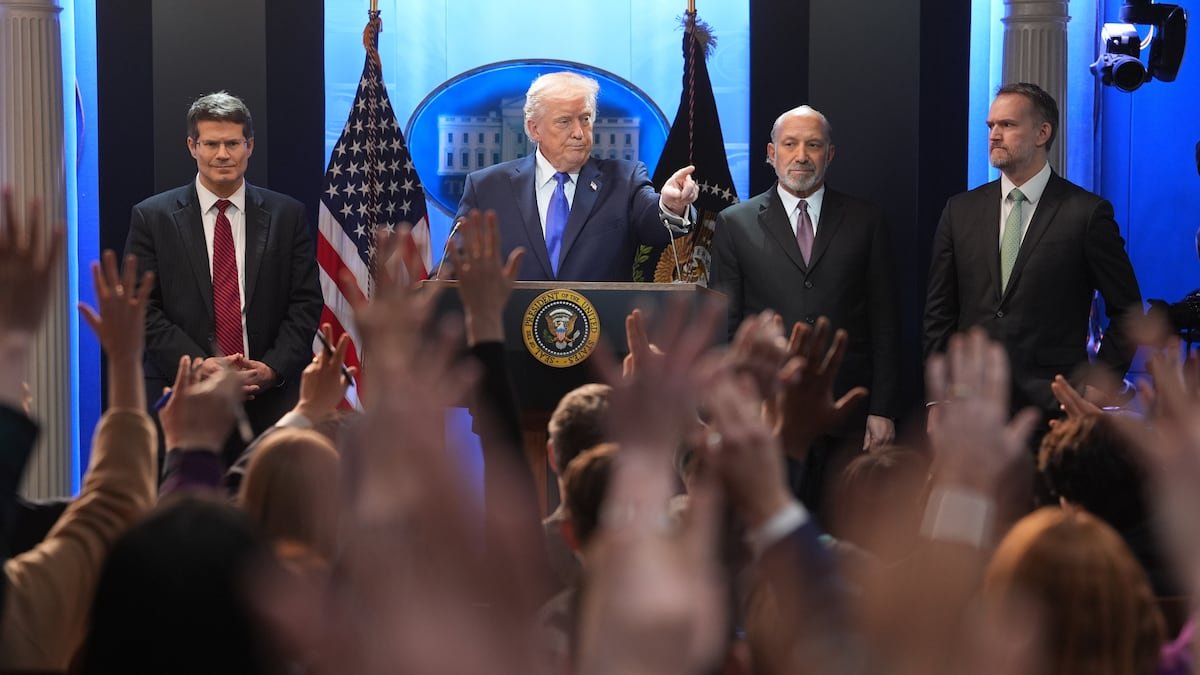
With barely any time to recover from the blow, Donald Trump appeared early Friday afternoon in Washington to respond to the Supreme Court ruling that had declared a large portion of his tariffs unconstitutional just three hours earlier. The ruling was a bombshell: not only did it push the U.S. government’s economic policy into the abyss, it also robbed the Republican of a tool he has used at will to reshape the world order through threats of trade tariffs.
Speaking at the White House, Trump said he was “ashamed of certain members of the court, absolutely ashamed for not having the courage to do what’s right for our country,” while suggesting the court had been “swayed by foreign interests.” A visibly upset Trump congratulated the three justices who sided with him for their “strength and wisdom and love of our country, which is, right now, very proud of those justices.”
Before his appearance, the White House had dimmed the lights in the press room, where reporters waited expectantly for the urgently announced statement. The drama heralded by this gesture soon unfolded, as Trump repeatedly lashed out, in a flagrant violation of the separation of powers, against the judges who did not agree with him, calling them “lapdogs for the radical left” and describing the ruling as “deeply disappointing.”
He brought a written speech, at the end of which, and before taking questions, he said: “Effective immediately, all national security tariffs under Section 232, and existing Section 301 tariffs, remain in place, fully in place, and in full force and effect. Today, I will sign an order to impose a 10 percent global tariff under Section 122, over and above our normal tariffs already being charged. And we’re also initiating several Section 301, and other investigations, to protect our country from unfair trading practices of other countries and companies,” he added.
The article on which Trump is relying for this new global tariff allows for it to be imposed for 150 days while it awaits congressional approval. But its wording allows for a loophole that no one can rule out the White House taking advantage of: if Congress refuses to act, the administration could, at least in theory, allow the tariffs to expire, declare a new balance of payments emergency, and restart the process. The maneuver would raise serious concerns about the separation of powers, but nothing in the statute clearly prohibits it.
Trump also warned that “there are ways” to circumvent the high court’s decision. “The ruling may not limit the president’s power to impose tariffs,” he said, after reading a portion of the dissenting opinion of Brett Kavanaugh, a judge he appointed, a decision he celebrated on Friday, stating he was “very proud of that appointment in actuality”.
Friday’s announcement was reminiscent of the one made by the White House last June, also on an urgent basis, allowing Trump to celebrate before the press the momentous Supreme Court ruling that limited the power of federal judges to issue rulings that oppose presidential executive decisions. He described that ruling as a “monumental victory for the Constitution, the separation of powers, and the rule of law.” The tone this time was very different.
Supreme Court reverse
Earlier Friday, the conservative-majority Supreme Court decided to overturn the so-called “reciprocal” tariffs that Trump indiscriminately imposed on more than 100 countries. The 170-page ruling threatens the U.S. government with the obligation to return tens of billions of dollars in unconstitutionally collected taxes. It is not entirely clear how this refund could be made, nor the final scope of the ruling, but there is no doubt it is of enormous significance.
The Supreme Court’s decision does not affect all trade tariffs imposed by the Trump administration. It addresses only the so-called reciprocal tariffs, most of which target trading partners, and others aimed at China, Canada, and Mexico. These are the tariffs Trump enacted by invoking the 1977 International Emergency Economic Powers Act (IEEPA). There are other specific trade tariffs, such as those on aluminum and automobiles, that are not affected by this decision. The court considers that Trump is making widespread use of the emergency powers considered under the law and is therefore abusing it.
The majority opinion was signed by Chief Justice John Roberts and has the expected support of liberals Ketanji Brown Jackson, Elena Kagan, and Sonia Sotomayor, as well as conservative justices Neil Gorsuch and Amy Coney Barrett. Gorsuch, appointed by Trump during his first term, already expressed skepticism about the Republican’s tariffs during the oral hearing in November. This result (6-3) is common in the current Supreme Court, with a conservative supermajority that hasn’t been seen since the 1930s, but it usually serves to leave the three liberal judges in the minority.
The Supreme Court has shown a strong tendency to agree with Trump in his sustained strategy of expanding executive power, which this ruling contradicts. The news comes four days before the State of the Union address, the first to be given by the U.S. president since his return to power. Friday’s setback will undoubtedly influence the drafting of that text, after weeks in which the Republican has directly and indirectly pressured the Supreme Court justices to rule in his favor.
There were two dissenting opinions: that of Clarence Thomas, the most senior and most right-wing of the judges, and that of Kavanaugh, one of the three justices appointed by Trump in his first term.
In the latter, 63-page document, Kavanaugh anticipates that this ruling will spell “disaster” for the U.S. economy. “The interim effects of the Court’s decision could be substantial. The United States may be required to refund billions of dollars to importers who paid the IEEPA tariffs, even though some importers may have already passed on costs to consumers or others,“ Kavanaugh writes. ”As was acknowledged at oral argument, the refund process is likely to be a ‘mess.’”
U.S. Trade Representative Jamieson Greer said a few weeks ago that if the Supreme Court rules against the tariffs, the administration would “start the next day” to reinstate them “to respond to the problems the president has identified.”
Previous skepticism
The decision, which deals a fatal blow to Trump’s economic agenda, comes three months after the Supreme Court hearing to examine the legality of the trade tariffs. The judges heard arguments from both sides on the president’s authority to invoke the IEEPA in designing his tariff policy. During that hearing, which lasted more than two hours, the justices’ skepticism about its legality came to light.
The IEEPA was passed nearly half a century ago by Jimmy Carter to limit presidential power in foreign economic matters after Richard Nixon’s attempts to bypass executive limits.
The White House had already contemplated the possibility of a Supreme Court setback and said it would resort to other legal means to maintain the tariffs. The government had considered at least five alternative ways to maintain or reapprove the tariffs.
Although the ruling does not expressly mention it, the Supreme Court decision poses a huge threat to the Trump administration due to the taxes that were improperly collected. The Republican had declared earlier in the week that without tariffs, the U.S. would be “financially defenseless.”
On Friday, Trump said his plan would avoid that extreme. Some $150 billion collected in the last year in trade taxes is up in the air, and the ruling does not specify what will happen to it. “I guess it has to get litigated for the next two years,” the Republican warned.
“So they write this terrible, defective decision, totally defective. It’s almost like not written by smart people” he later replied to a press question regarding potential refunds. “I just told you the answer. It’s not discussed. We’ll end up being in court for the next five years,” he added, in another tirade against the independence of the Supreme Court justices.
The ruling resolves two lawsuits filed by an Illinois toy company and a New York family-owned wine and spirits importer, representing several hundred small and medium-sized businesses grouped around the We Pay the Tariffs platform, in addition to those filed by a handful of Democratic lawmakers.
The lawsuits reached the Supreme Court after lower courts ruled that the IEEPA does not grant the president unlimited powers and does not give him the authority to impose tariffs indiscriminately.
The plaintiffs argue that the law passed by Carter in 1977, which Trump has relied on to justify his tariffs, does not mention the terms “tariffs,” “customs duties,” “taxes,” or “levies.” That was precisely one of the arguments made by attorney Neal K. Katyal, who represented the companies during his intervention at the Supreme Court hearing. The other is that the IEEPA has been used numerous times over the past 50 years to “impose sanctions, but never,” the lawyer proclaimed, “not once, to dictate tariff policy.” Katyal recalled that the power to impose taxes was granted to Congress by the “founding fathers.”
Since April 2, the day Trump proclaimed as “Liberation Day,” the United States has imposed indiscriminate tariffs on more than 100 countries. These are import taxes ranging from 15%, which has been set for most blocs, to 50% for India and Brazil. The Trump administration has also established special rates for countries, for general sectors, but also for specific products based on its interests, which are not necessarily commercial, such as tariffs on steel and aluminum, the automotive sector, and even bathroom vanities.
The White House has invoked the IEEPA to impose five types of tariffs: reciprocal tariffs, tariffs related to fentanyl, tariffs linked to Russian oil imports, tariffs applied to Indian and Brazilian products, and tariffs on trade agreements negotiated by other countries under the law.
Sign up for our weekly newsletter to get more English-language news coverage from EL PAÍS USA Edition