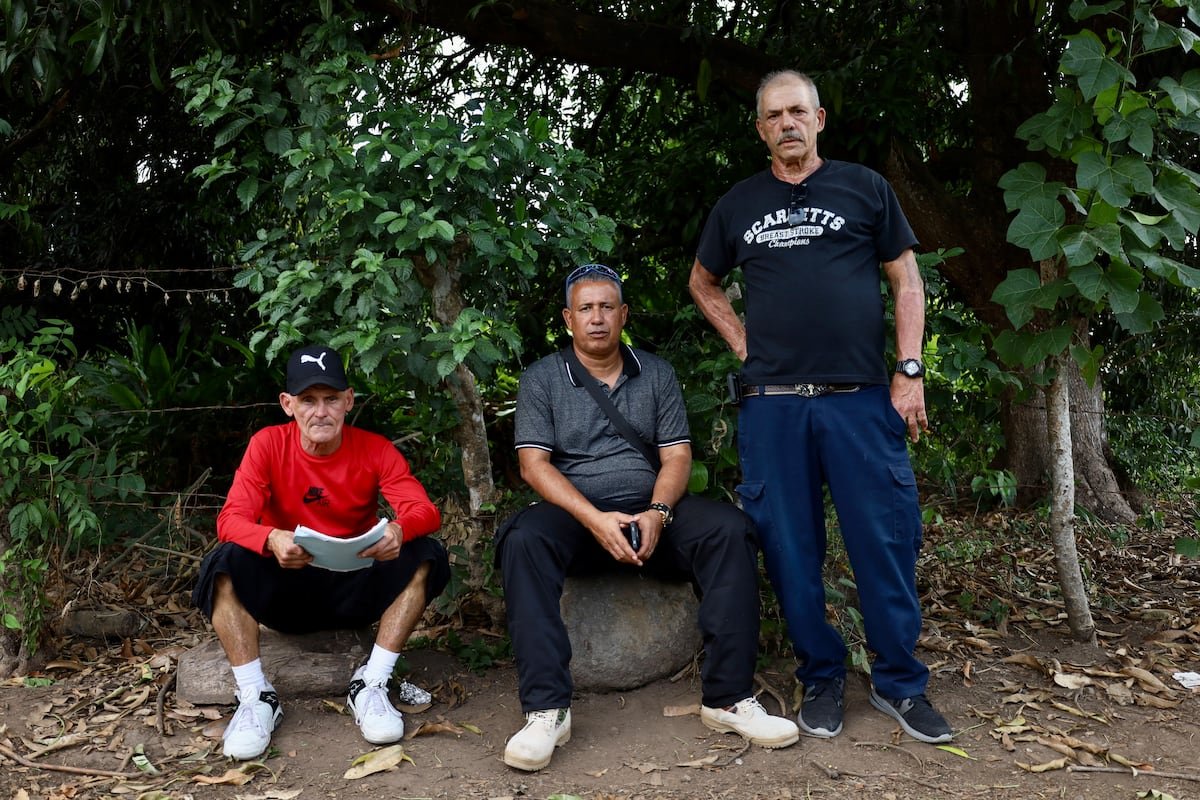
Just a few weeks ago they were electricians in Miami. Or department managers at a multinational corporation. They were still fishing, just like they had for the last 30 years. They drove trucks. They owned an air conditioning company. They were collecting retirement benefits after a lifetime of work. And now? Now they look for a gap between the arcades, hang wet clothes to dry in a sink, open and close the doors of an Oxxo convenience store hoping for a few coins, celebrate the blankets that a kind neighbor gave them so they don’t have to sleep directly on the hard concrete floor, treasure worn papers, documents in the wrong language, and rely on promised money to buy a cell phone so they can call their families, who remained thousands of miles away, on the other side of the border.
They are in Tapachula, a city that for years functioned as an open-air prison for thousands of migrants who carried the weight of their travels and who now no longer arrive, frightened away by Donald Trump’s policies. That anti-immigrant strategy is the same one that has now reached them — Cubans with lives built in the United States. ICE, the U.S. immigration agency, tore them from their homes and dumped them here, in a poor city in Mexico’s poorest state. Many dream of returning; they plead, they wait. Others, with wrinkled eyes, complain: “I cry at night, I cry in the morning. Look around you, we’re all old, what are we going to do here?” asks Lázaro Ballesteros, who spent 47 of his 53 years in Miami.
Mexico accepts deported foreigners from the United States as a “safe third country.” Under the Biden administration, an agreement was reached to receive 30,000 per month (Nicaraguans, Cubans, Haitians, and Venezuelans who had crossed the border illegally). Now, under Trump, there is no quota, at least not publicly. However, Federal Judge William G. Young stated in a ruling that the Department of Homeland Security (DHS) informed him that, based on an “unwritten agreement,” it deported 6,000 Cubans to Mexico in the last year. According to Tapachula authorities, most of these deportees in 2026 have arrived in Tapachula and Villahermosa. This newspaper has asked the National Institute of Migration (INM) about these figures, as well as why these two locations were chosen as receiving destinations, but has not received a response.
The decision to send them to Tapachula caught by surprise local authorities already seasoned in dealing with people in transit and migrant caravans. “It’s a completely new situation for which no one was prepared. We’re worried,” acknowledges Denisse Lugardo, director of International Relations and Cross-Border Development. She admits they are still awaiting instructions from the state or federal government. No one notified them that the Cubans, who have been arriving by the dozens in INM trucks from the northern border for the past couple of months, were being sent there — a three-day road trip.
Now, with the help of activist Luis Villagrán, these Cubans are fighting for legal protection to obtain a humanitarian visa, which would allow them to reside and move freely within Mexico, given their stateless status. The city council is aware of the initiative and supports it: “It’s one of the primary conditions of vulnerability; in that case, it’s absolutely essential that COMAR (the Mexican Commission for Refugee Assistance) or the INM grant them the visa.” For the U.S. government, “their deportation to Cuba has been considered impractical, inadvisable, or impossible.” “They told me at the Arizona detention center: ‘Cuba won’t accept you,’” says 63-year-old Jesús Gutiérrez. Niorje Rodríguez even attempted the journey to the island from Tapachula: he went to the immigration office and asked to be deported to his country: “Instead, they sent me to Guatemala. From there I came back, crossing the river, and here I am, sick, sleeping on the street.”
Cuba, which is mired in its worst crisis in decades, evokes mixed feelings in these men. Most left as children, some fleeing the Castro regime, others simply out of poverty. Many no longer know anyone in the country, but some plead to be sent back to see their ailing mother one last time or embrace a brother after 40 years. If neither the United States nor Cuba is an option, many seek at least to reach Cancún, where a network of Cubans is being established; or to some other country where they can work and support themselves. “Here, I can’t find a job I can do at my age. Sometimes, when I’m desperate, I unload 100-pound sacks from trucks, but I’m in a lot of pain the next day,” says Eduardo Soto, 62. Others, like William Herrero, 54, got hold of a thermos and make coffee in the morning to distribute throughout the day, charging 10 pesos (less than a dollar). Lázaro Ballesteros, who describes himself as a “professional tile maker,” bought fishing gear: “There aren’t any fish here. Nothing moves here. What there is here is poverty.”
Arsenio Chirino, 76
He limps through the central park carrying an empty water bottle and the food left behind by another man: “So it doesn’t get stolen,” he explains. He poses sadly for photos, after remembering Mateo, the six-year-old grandson he cared for in recent years and whom he hasn’t seen in seven months. Arsenio Chirino is 76 years old, has had heart surgery, and suffers from high blood pressure. He tires easily in this tropical heat, eats little and poorly, sleeps on the ground, and begs, by any means necessary, for someone to send him back: “I’m old now, I don’t want to die here.”
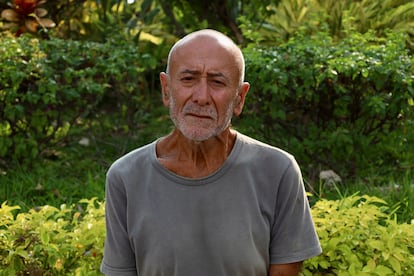
He remembers the day he arrived in the United States, on May 5, 1980, better than the day he was deported to Mexico. ICE detained him, like almost everyone else, while he was signing the revocation of his deportation order. He was imprisoned when he was already an old man, accused of drug possession, a crime he insists he didn’t commit. Be that as it may, he paid for it for seven years. In September he was sent to Villahermosa, the other destination for deportees from third countries. But five months later — he doesn’t know why — the INM transferred him to Tapachula, along with a young man and a man in a wheelchair. In the state capital of Tabasco, he thinks he was somewhat better off because he found a shelter nearby; here in Tapachula they are far from the city center, and in that isolation “he’s filled with thoughts and sadness,” which is why he prefers the streets. His last request is frank: he doesn’t want to die, after a lifetime working as an electrician in the U.S., in a place where he doesn’t know a soul.
Rolando Tito Vega, 50
“What are you doing in Mexico?” the lawyer asked Rolando Tito Vega when he called her two months ago for help. He’s still asking himself the same question. It was January 9 and he was working in his office as a department manager when ICE showed up. They were supposedly looking for him because of a 25-year-old sanction for which he hadn’t even served time and for which he had already received a pardon. It didn’t matter. In 11 days, he was already on the Arizona-Mexico border: “They offered me a federal prison to wait for my case to be resolved, but I’m not going to jail for something I didn’t do. So they took me to Mexico.” He says a judge has acknowledged the error, but now the U.S. government is demanding a $9,400 fine (“as if I had left the country voluntarily”) to return. It’s money he still doesn’t have. He has five children in Miami, where he has lived since 1995. They now run the air conditioning business he started and help him survive in Tapachula.
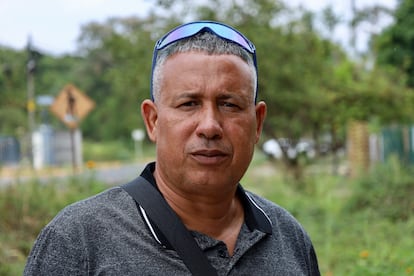
Juan Carlos Rodríguez and Jesús Gutiérrez, 44 and 63
Last Wednesday, Juan Carlos Rodríguez, a chef by trade, didn’t feel like cooking anything. So he went down to buy some tamales at the entrance of the hotel in downtown Tapachula where he lives with Jesús Gutiérrez. He paid for them, went back upstairs, and said that immigration officials had asked for his documents; he’d bring them down quickly and be right back for lunch. Minutes passed, and nothing happened. When Gutiérrez, worried, went down to the street, he found Juan Carlos already inside one of the INM’s vans. Without any explanation, the federal agency had conducted a raid and taken Juan Carlos from the first floor, three Haitian women with their children from the second, and another young Cuban man from the third. They were released, without further ado, a few days later.
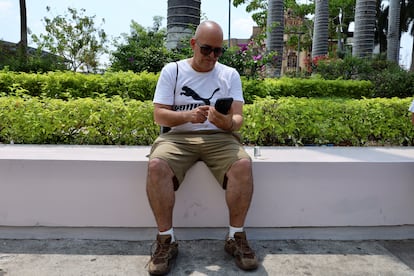
The Siglo XXI center is the third immigration detention center that Juan Carlos, 44, has been in during the last six months. He was arrested on September 12 in the streets of Old San Juan, Puerto Rico, on his way to work at a Puerto Rican restaurant where he was one of the chefs. He was flown directly to Alligator Alcatraz and held for 86 days. There, he was told he would be sent to Mexico, but he refused to sign the deportation papers. He spent another two months in an Arizona jail until February 9, when they were taken to Mexico. “Many of my companions didn’t want to get on the trucks to come here. They were beaten, subdued, and then forced on,” he recounts. It was in Tapachula where he met Jesús, and they rented an apartment together in the hotel for 12,000 pesos a month (about $650), with the money their families send them. “All my life paying taxes, income tax, licenses…,” says Gutiérrez: “Only to end up here.”
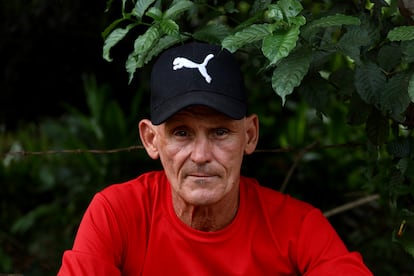
William Herrera, 54
William Herrera says his family crossed the 200 miles from Villa Clara, Cuba, to Key West, Florida, on March 11, 1994: “When Fidel said anyone who wanted to could leave.” He was 22 years old at the time and did the same work he did back home: fishing. A year after arriving in the U.S., a wood-shredding machine took off the fingers of his right hand, but he continued working “on the boats” and “preparing fish” for 30 years. Because of a felony he committed in his youth, he spent years traveling to Miami to sign the revocation of his deportation order. He was never arrested again for anything. In October 2025, he was detained at the courthouse and transferred, like most of the others, to the infamous Alligator Alcatraz, the migrant detention center built by Trump that has accumulated dozens of complaints of human rights abuses. “It’s terrible in there,” Herrera says. “It’s a cage,” Eduardo Soto adds: “You’re with 32 other people inside a cell all day, you only get out to eat three times a day and to shower on Mondays, Wednesdays, and Fridays. Nothing else.”
Sign up for our weekly newsletter to get more English-language news coverage from EL PAÍS USA Edition