At Beijing’s train station, inaugurated by Mao Zedong himself in 1959, waiting hall number four is overflowing. At the far end of the hall, amid austere marble columns and dozens of travelers, a neon sign indicates that the legendary K-27 overnight express to Pyongyang, the capital of North Korea, is about to depart. The resumption of the route two weeks ago, after a six-year suspension, signals a shift toward openness in the reclusive nuclear nation. “It will contribute to boosting exchanges between the two countries, as well as economic and trade cooperation and cultural exchanges,” announced the Chinese state press. Air service between the two capitals was also scheduled to resume on March 30.
The overnight train takes 25 hours to travel from Beijing to Pyongyang. Most passengers, however, get off in Dandong, a Chinese city on the border. From there, only a handful of travelers with North Korean passports and Chinese citizens with student or business visas continue on. Since the pandemic, the country ruled with an iron fist by Kim Jong-un has not admitted tourists — except for Russians, with whom they have recently been getting along particularly well — and it certainly doesn’t welcome journalists. Even so, it’s worth taking the K-27 express: the 1,103-kilometer (685-mile) journey from Beijing to the North Korean border is the closest a Western reporter can get to the hermetic Asian dictatorship.
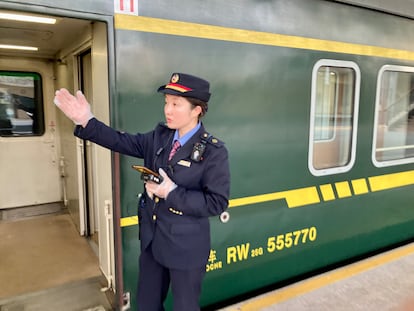
The train, like almost everything North Korean, is shrouded in mystery. Passengers bound for Pyongyang are summoned to a different station room, undergo a separate security check, and are led down another corridor to the far end of platform 12, where two differently colored carriages have been attached to the rear of the train: there they have their sealed compartment, their own private space, a North Korean bubble in which they cannot interact with the rest of the passengers. Chinese police hold back curious onlookers who approach, but there is enough time to see the North Korean conductors, with their enormous peaked caps.
The train departs promptly at 5:27 p.m., and as the endless urban sprawl of Beijing recedes into the distance and darkness falls outside, passengers in the second-class sleeper car while away the time watching videos on their phones, dozing, sharing dinner at the small table, and chatting. “North Korea is a very poor country,” says a talkative 64-year-old woman, whom we’ll call Shaodan — she didn’t give her name. She’s returning to Dandong, the border city, after a couple of years living with her son in Beijing. She’s retired and has traveled to the neighboring country often. “When I worked as a nurse at the hospital, we used to donate instant noodles, kitchen utensils, and that kind of thing that nobody wants in China,” she says. “Because they’re so poor…”
These carriages, with no doors between the aisle and the rows of three beds, are an ideal place to chat with ordinary people. A 19-year-old boy explains that he is returning home after three days of unsuccessfully searching for a job in the capital; a mother and her daughter are also returning after the daughter underwent surgery — “we preferred a good hospital in Beijing”; a patriotic woman praises the work of Chinese President Xi Jinping: “Look at the conflict in Iran now,” she sighs. “In China, on the other hand, everything is peaceful.”
In the dining car, they serve a set menu of rice and a meatball with chicken and vegetables for 30 yuan ($4.30), and the place, with its tablecloths, waitresses in caps, and the group of drinkers seated at one of the tables, has the feel of train journeys from yesteryear. Chang, a man in his thirties traveling as a tourist, takes a sip from his bowl of beer and explains something about the northeastern provinces of China, where the train is headed: “It used to be a vibrant industrial belt, but many factories closed, and the population has left to make a living elsewhere.”
Early in the morning, a beam of sunlight hits the rumpled sheets on the bunks, and the smell of cigarettes from smokers still lingers between carriages as the train pulls into Dandong. Amid the throng of passengers, five burly-looking men are speaking Korean on the platform. They don’t seem pleased to have been spotted. “I don’t understand you,” they say, trying to slip away. It turns out they were the ticket inspectors, and they refuse to answer any questions.
At the entrance to Dandong Station, next to an imposing statue of Mao, there’s a second chance to approach a North Korean. Travelers, soon to board the K-27 express to Pyongyang, are milling around the entrance. They’re easily recognizable by certain details: the men wear extremely baggy trousers that almost cover their shoes; the women sport unusual makeup, far removed from current fashions. All refuse to speak, except for one man, Mr. Tsoi, who is returning from a few days visiting distilleries in China. He’s carrying back boxes labeled “personalized liquor.” Regarding life in his country, he says, “It’s very good.”
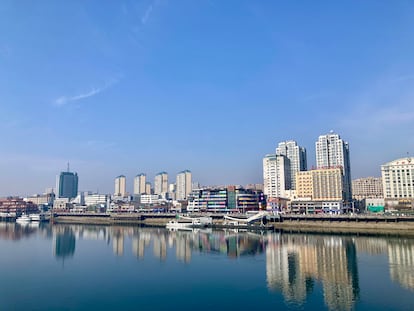
With just over two million inhabitants, Dandong is separated from North Korea by the Yalu River, whose waters form the border. During the Korean War (1950-53), it was a strategic point through which Chinese soldiers and military aid entered the country, aid that Beijing provided to the North Koreans to fight against the South Korean troops, supported by the United States. Nicknamed the “city of heroes,” here, grandparents still recount anecdotes of the American bombings. Its history and location attract travelers from all over China.
The broken bridge over the Yalu River, bombed by the Americans in 1950, is the main tourist attraction. The damaged infrastructure only extends halfway across the river, right to the border, and visitors from the Chinese side approach the end to get a closer look at their neighbor. Some bring binoculars. Others zoom in on the images on their phones. On the North Korean bank, about 200 meters away, a water park with enormous slides stands out — closed during the off-season — a factory with a tall chimney, a rounded building that, according to a local guide, is a five-star hotel called Kim Il-sung, after the grandfather of the current leader; a few people can also be seen, and cars that appear to be Chinese. There is life.
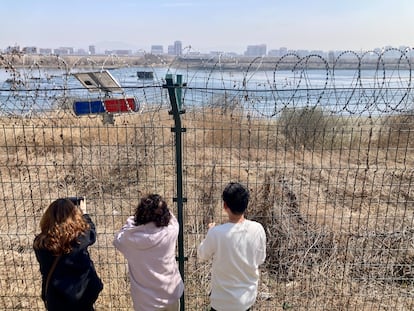
“The happiness index there is very high. They don’t have to pay for doctors or school because it’s a communist and socialist country, and there are no classes of rich and poor,” a retired Chinese military officer says from the bridge, while patriotic songs about the noble blood of those who have fallen in combat play in the background. He approves of the fact that their North Korean “brothers” possess the atomic bomb: “They have it to defend themselves, unlike the United States.”
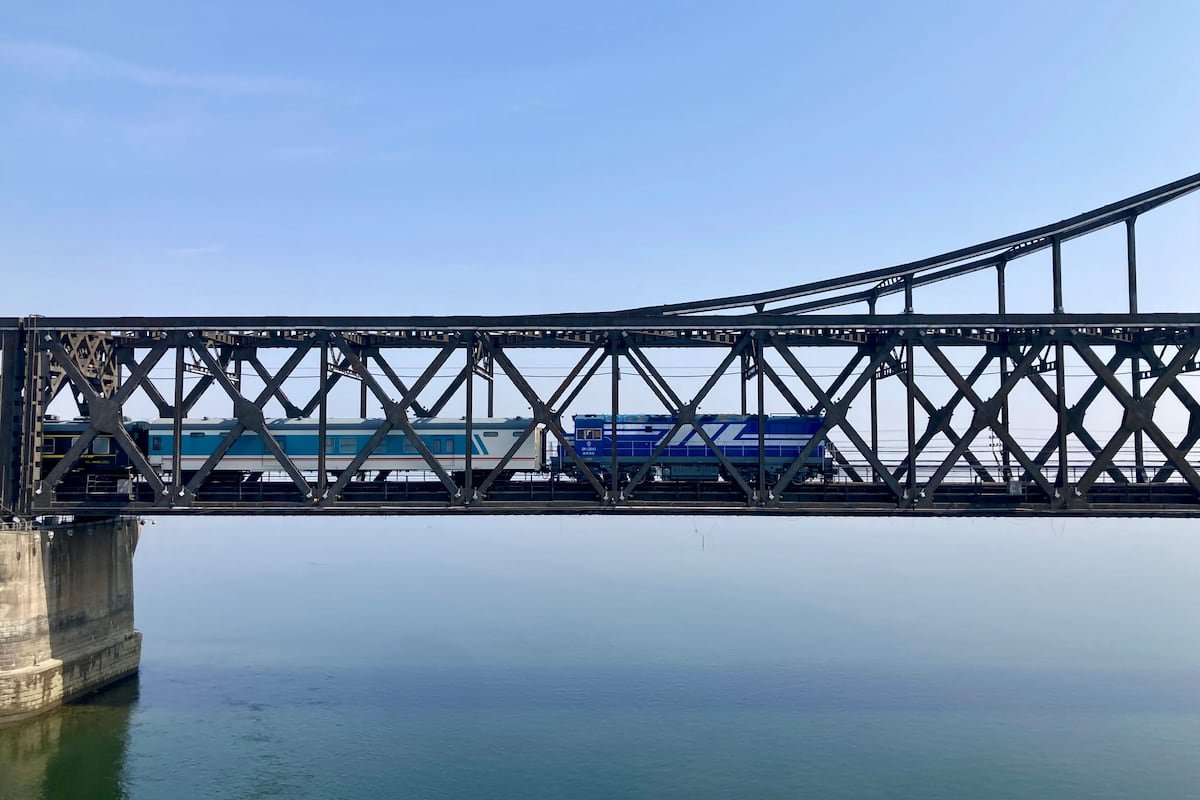
Alongside it runs the more modern Friendship Bridge, where the Pyongyang Express train clatters along with a long, drawn-out whistle. This is the conduit connecting the two countries, and truck traffic is constant; even buses and a freight train pass by. Last summer, traffic was practically nonexistent. It seems that trade from the past is being revived.
In this place, you get used to having North Korea constantly on your mind. You can, for example, go to an official North Korean restaurant, where the waitresses, at Pyongyang’s beck and call, are known for their curtness. Photographing them is forbidden, and they’re always on the lookout. They’ll quickly issue a reprimand if they catch you. They are very young, dressed, styled, and made up in a uniform way. When they have nothing to do, they stand by the table whispering what sounds like a prayer.
— What are you murmuring?
— Chinese refresher. I’ve only been here a month.
— And what do you think of China?
– Not bad.
Much of Dandong’s economic activity revolves around the neighboring country. On the pleasant promenade along the Yalu River, street vendors offer all sorts of contraband goods: “Hey, this is the brand of cigarettes Kim Il-sung smoked. I’ll give you a pack for 70 yuan [about $10].” And in the arcades, shops selling North Korean ginseng root mingle with agencies offering river cruises, promising to glimpse as much of the mysterious neighbor as possible, but without actually entering. “Otherwise, the North Korean soldiers will kill us,” concludes Mrs. Hu, the tour guide leading one of these expeditions, with a somewhat sadistic laugh. Her agency doesn’t accept Americans, South Koreans, or Japanese.
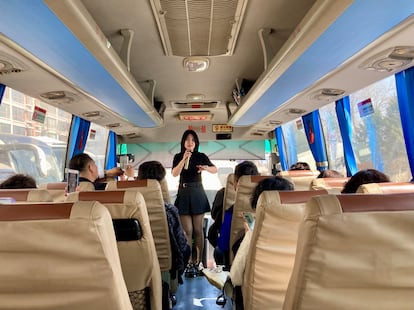
Mrs. Hu takes the microphone on the bus and doesn’t stop talking the entire way to the pier. She has an extraordinary knack for selling all sorts of products to the eager Chinese tourists. Since it’s a long trip, the bus stops at various points so they can observe their neighbors, while the guide emphasizes the poverty on the other side: “In North Korea, they’re thin because they’re poor […] Everyone is thin except for three people: the three members of the Kim family.” There’s laughter. “North Korean women like fat men with sunglasses and leather shoes.” More laughter. “At night, all the lights are on here. There, they stay in the dark. They’re really poor.”
“That’s the women’s prison,” the loudspeaker on the small boat announces. It has just set sail and is quickly approaching North Korea, so close you could swim across in a couple of strokes. The landscape is rural, with gentle, camel-colored hills. “That’s the Workers’ Party school, where they teach civil servants and military personnel.” Many of the buildings look dilapidated. Fields stretch out before you, where farmers work with hoes and plow the land with oxen. The few cars on the road kick up dust on the dirt tracks. For a while, the boat sails alongside a couple of cyclists pedaling along the border fence. Riding old bicycles, they seem to have stepped out of another era. A young man waves briefly.
“Life is very difficult there,” sighs Chen Ying, a tourist from Jiangsu province. For many Chinese, looking across the border is a reminder of how much their country has changed in recent decades. “It reminds me of China in the 1970s,” she says, gazing at the North Korean hills. Chen believes North Korea should follow China’s example.
Sign up for our weekly newsletter to get more English-language news coverage from EL PAÍS USA Edition