

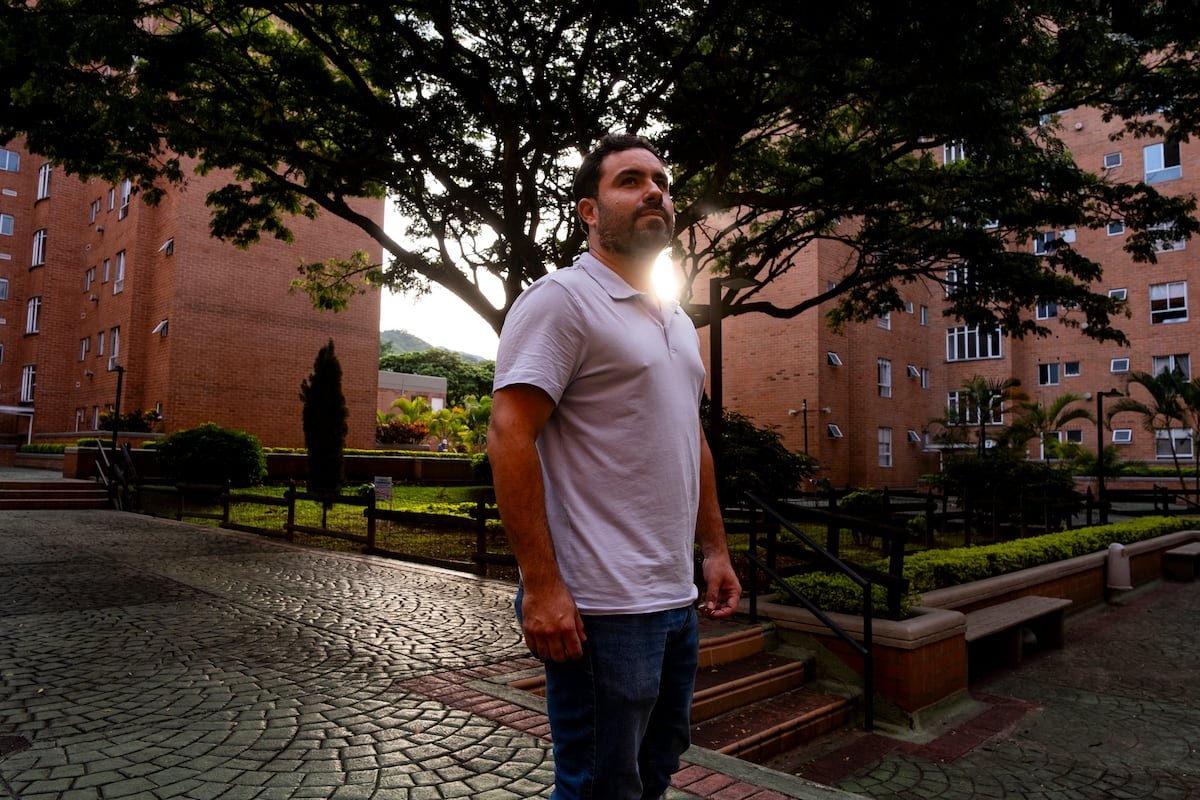
Rafael Velázquez knew guards could find his diary in any search, so after finishing each page that he wrote on the back of official forms, he folded it several times and hid it in a plastic bag among the showers at Alligator Alcatraz, the immigrant detention center in Florida’s Everglades. During the two months he was held there, he wrote more than 20 pages.
“My idea was for the world to know what was happening there, but in our handwriting from the inside,” explains Velázquez, a Colombian who had applied for asylum in the United States and was deported back to his country last month. “I know that one day everything we had to endure at Alligator Alcatraz will come to light.”
Velázquez arrived in the U.S. via the border with Mexico and applied for asylum in early 2023. He had work authorization through 2030, a Social Security number and a driver’s license. He found a job at a dairy distribution company and was “doing very well.” However, on April 14, he was stopped by Border Patrol while driving his Toyota Corolla near the Hard Rock Casino in Hollywood, north of Miami. He had not committed any traffic violation, was not under a deportation order, and had no criminal record. The agent told him he had been stopped for an immigration check. Velázquez suspects the officer had information about his immigration status based on data linked to his vehicle.
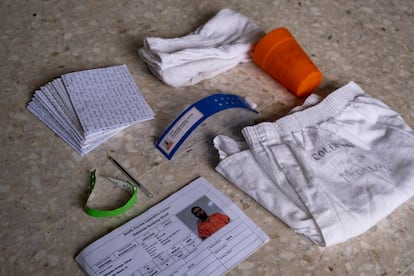
When he left Alligator Alcatraz in June, Velázquez took with him the diary hidden among his legal documents. He also kept the electronic ankle bracelet the guards used to identify him during the head counts conducted every six hours; an orange silicone cup he managed to smuggle out hidden between his feet; a pair of socks and a pair of underwear. Detainees were not allowed to leave with those items; they had to leave them at the center before being transferred or deported. While some may seem insignificant, for Velázquez they are material witnesses to what he describes as his time in a “concentration camp” for migrants.
In the diary, Velázquez alternates everyday details with prayers and messages to his partner. “Carolina, my darling, my wife, it is hard to keep your sanity in this situation, but reason and sanity remain intact thanks to the hope of seeing and hugging you again. That gives me strength every minute I spend in this concentration camp. I am in a cell with 30 people of different nationalities, without a telephone to notify our families, without sheets, pillows, or blankets. We are at the mercy of our kidnappers, with no idea of the time or our destination. All that remains is not to let yourself be broken mentally and to have faith in God. I dream of waking up by your side every day of my life, traveling together, with the farm, with the animals we will have, and with so many dreams that one day we will live, giving thanks to God and remembering these sad days,” he writes in a cursive hand with long, steady strokes.
The time appears over and over again throughout the diary, even in the middle of a sentence. Because they had no clock, whenever someone managed to make a phone call, they would ask what time it was and then share it with everyone else. It was the only way to avoid losing track of time. He also made highly detailed drawings of the telephone and the wire-mesh cell door. He wanted to document everything.
Two weeks after arriving at the center, the diary recorded one of the most uncertain moments: “Sunday, April 26, 2026. It is 2.44 p.m. in cell Alpha 1, Section 4. I heard my name: ‘Rafael Velázquez, gather your things!’ Still half asleep, I called Carolina, a quick call; I only told her they were taking me but I didn’t know where. She only told me: ‘I love you. Don’t worry, God will perform a miracle.’ I told her I loved her and, with a hollow fear in my stomach, I left the cell, but not before hugging those who stayed, with those faces of anguish and desolation. They changed our orange uniform and gave us a gray one, but this time they gave us shoes. They say they are taking us, but we don’t know where. That uncertainty eats at you to the core.”
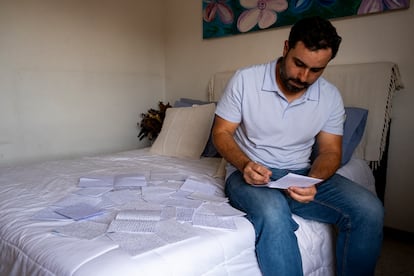
Velázquez came close to being deported, but an error in the detainee headcount led authorities to cancel the operation. In a diary entry written two days later, he described the experience: “At dawn on Monday they chained us at the chest and abdomen and put handcuffs on our waists and feet. They loaded us onto a bus, and we left with no idea of the destination and the discomfort of the chains. I looked through the crack in the driver’s window to try to orient myself. After more than an hour, the bus arrived at Miami’s Opa-Locka Airport, and there were already two planes waiting. After praying to God on the way, I begged not to be put on that plane. They called our names from the list, and we started getting off, but there was an error, and they sent us back to Alligator Alcatraz. God is great! Chained for 12 hours and joyful, with an immeasurable tiredness. I was able to speak with my love. The miracle happened!”
Velázquez says the orange cup “has special value” because the guards “were very strict about not being able to take it out” and because of how difficult it was to smuggle it out, a feat that even required help from another detainee, a Colombian from La Guajira.
To leave the facility, he had to pass through two searches. He hid the cup in the waistband of his pants and, during the first inspection, took advantage of a moment when the guards were distracted. He let it fall, grabbed it with his feet, and passed it to his companion like a soccer ball.
“My companion tucked it between his flip-flop and his foot. Since the cup is silicone, it bends. When I got on the bus, I took off my sock and put it on the sole of my foot. Then we went through another search, also very thorough, but they didn’t manage to see it.”
“It’s like a trophy, like when soldiers keep a souvenir from war,” he adds.
Psychology describes such belongings as “linking objects”—items that maintain a connection to a traumatic episode to validate that it really happened and help process it. Velázquez hopes that one day these objects may end up in a museum, serving as testimony to what occurred.
‘A hole’ that seemed impossible to escape
For others, like Pedro Jaimez Varela, a Venezuelan who spent three months detained at Alligator Alcatraz, these objects are evidence of something they do not want to be forgotten. Jaimez Varela keeps a small collection framed in a display. His registration sheet, letters and hand-drawn calendars form a collage with a packet of dried cranberries, a wristband with his name and a cardboard spoon that sticks out like an improvised mat.
“I kept the cardboard spoon we ate with, the deodorant, the toothpaste and other items they gave us during detention. It was truly so inhuman. You feel like you’re in a hole you can never get out of. All the detainees got sick. There was a lot of hunger, and the water tasted like chlorine,” says Jaimez Varela, who was detained in March at a traffic stop while returning from a baseball game by the Venezuelan team in Miami. He had no criminal record. In May, he was released on $10,000 bond.
Velázquez fought his case in immigration court while detained until June 9, when he agreed to voluntary departure. “I reached the limit of the abuse,” he says. “Every square meter of that place is designed to make your life more bitter, from the racist treatment by the officers to the food. I could have continued fighting the case, but that would have meant staying eight months in that place.”
He was deported to Medellín on June 12, the day he turned 37. He says it was “a true divine gift to get out of there that day.”
Shortly after Velázquez accepted voluntary departure, Alligator Alcatraz was closed. The last detainees were transferred to other immigrant detention centers in Florida and other states. During the nearly 12 months it was open, about 21,000 people were “processed” at the site, according to Florida Governor Ron DeSantis. The center, accused of human rights violations, became one of the most controversial symbols of President Donald Trump’s immigration policy and faces several lawsuits.
While Velázquez tries to rebuild his life in Medellín, the diary, the bracelet, and the cup are kept in a box at his friends’ home in Santa Elena, on the outskirts of the city.
Carolina, Velázquez’s partner, says the experience has changed the whole family. She has also begun making plans to return to Colombia, and her son has already left the United States out of fear that the same thing could happen to him.
“It was the most anguishing, most challenging and most fear-filled time I have lived in my whole life,” says the woman, who asked to remain anonymous for fear of reprisals from immigration authorities. “Before, you thought something like that would never happen to you. But when it gets so close, everything becomes pure fear.”
Sign up for our weekly newsletter to get more English-language news coverage from EL PAÍS USA Edition