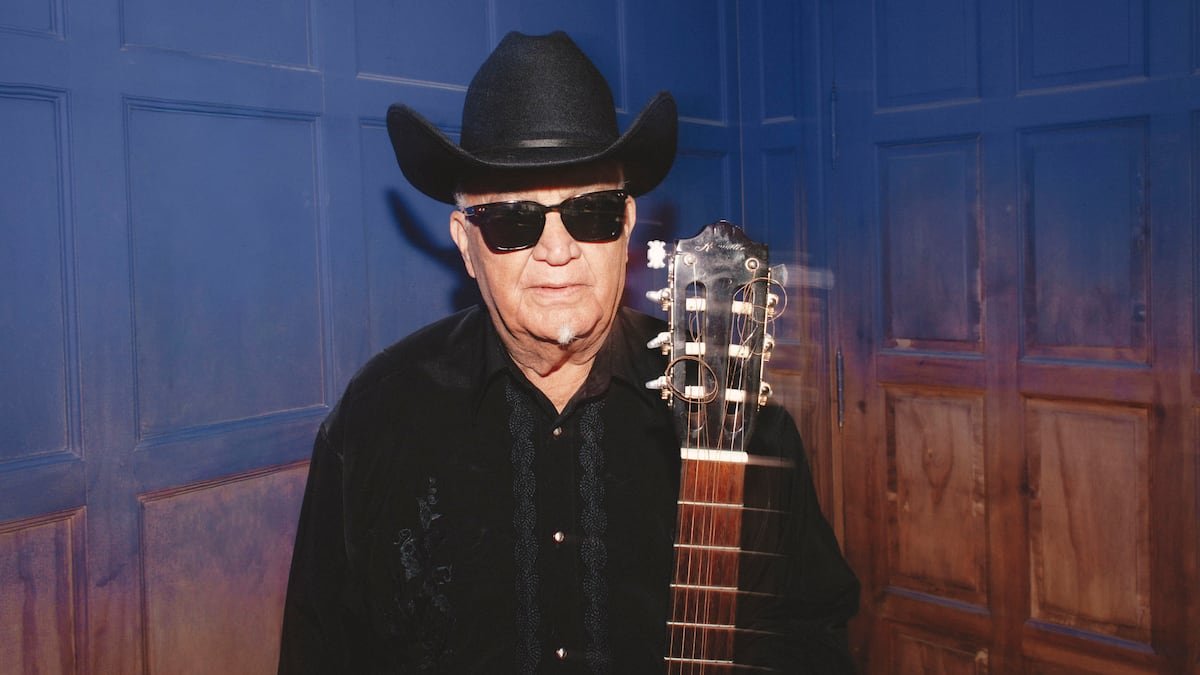
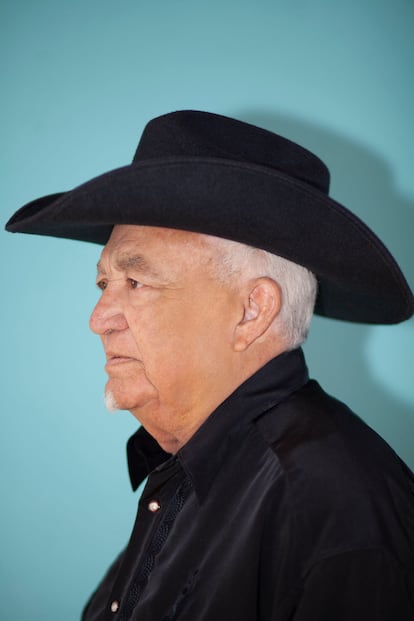
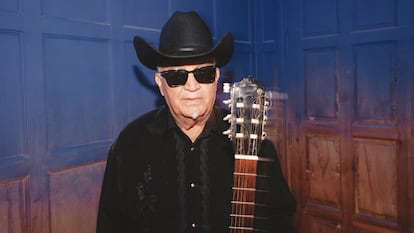
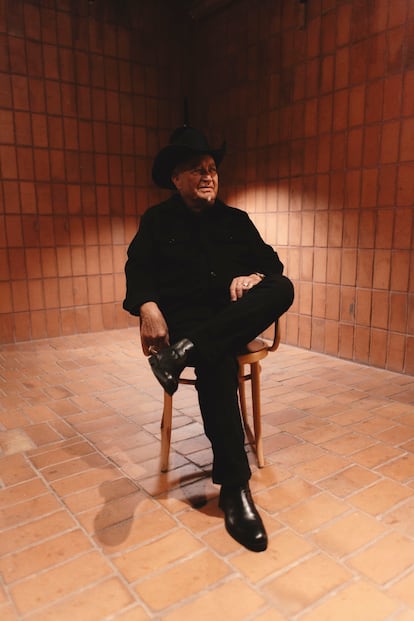
Glimpsed through the glass doors, the figure of Eliades Ochoa, 79, stands out from the rest: a burly and charismatic man dressed all in black, with boots and a large, matching cowboy hat. He seems alert to the slightest movement, and gives the sense of an old cowpoke in the middle of a saloon, with the important caveat that the Wild West dive bar in question is actually The Social Hub, one of the most modern hotels and venues in downtown Madrid, located just a few steps from Plaza de España. There are no vaqueros or waiters chewing tobacco here, but rather, tourists of all nationalities and an ample offering of breakfast and brunch menus. The music heard in the background comes not from a player piano, but is piped in from speakers, calming sounds that enhance the tranquil atmosphere of the luxurious space. And yet, Ochoa’s aura is so powerful that under the generous rays of sunlight streaming through the large window on this March morning, he evokes a Western film. “Nice to meet you,” he says, with a firm handshake. “I’m here to do my job,” he adds as he picks up his guitar, which rests in its case on the table as if it were a shotgun waiting to be slung over a shoulder.
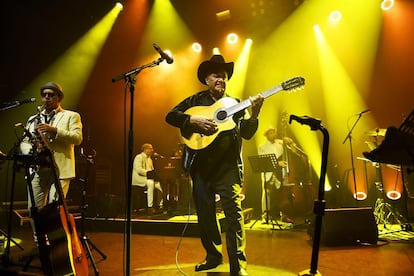
This singer-songwriter’s job is music, and more specifically, Cuban roots music, one of the world’s most fascinating musical legacies, which has influenced generations of rock, jazz, flamenco and folk artists. It’s a job he has held all his life, ever since he began to play the guitar almost before he learned to speak, through watching his father “play the tres”, a very popular traditional instrument in the western rural areas of the island that has become a symbol of Cuba. “Every night, my father came in from working in the field, and sat me in front of him to watch him strum,” Ochoa recalls. A largely self-taught performer with a highly personal style, he is the last great troubadour of Cuban music, and has been a national inspiration since he was very young. In the 1970s, he led the Cuarteto Patria, and set the foundations for current international fame by becoming one of the founders and the youngest member of the Buena Vista Social Club. As part of that incredible musical group, Ochoa, alongside others like Compay Segundo and Ibrahim Ferrer, led Cuban music to conquer the world in the 1990s. He’s still very much a part of that takeover, a fact recently evidenced when C. Tangana turned to Ochoa to bring his rhythms — blended with rumba — to Tangana’s hit album El Madrileño on the track Muriendo de envidia. In June, Ochoa will turn 80 in the midst of an international tour that will bring him to Spain: Barcelona on Sunday, Madrid on June 7, and to summer festivals like PortAmerica in Pontevedra. In Cuba, his artistic stature is comparable to only that of Omara Portuondo, who like Ochoa, received a lifetime achievement award from the La Mar de Músicas festival, one of Spain’s most prestigious honors for international folk musicians. With a mischievous smile, the master says, “People love me, and that keeps me healthy.”
Seated in an empty room away from the touristic hustle and bustle of The Social Hub, the almost-octogenarian cowboy of innocent eyes and a landing-strip goatee streaked with snow-white hair exudes an air of dignity. He speaks slowly, in short sentences, as if tuning a Cuban tres before a performance he knows will be spectacular. They say that after meeting Ochoa in person, actor Benicio del Toro called him “the Johnny Cash of Cuba”. Thoughtful and with his gaze fixed on the interlocutor, this man in black from the countryside looks back, reviewing a lifetime dedicated to music. He recalls those long-ago days in the village of La Loma de la Avispa when the son of Aristónico Ochoa and Jacobina Bustamente, a farmer and a housewife, spent his evenings with them playing and singing after their day’s work in the fields. “It was my mom who told my dad that I was imitating him,” Ochoa recalls. “She said, ‘You play at night, and the next morning, the boy does what you do, and he does it very well.’” Their town was located in the Guajira region, a mestizo land shaped by both Spanish and Indigenous heritage, a place of men in yarey hats with machetes at their belts, where the tres and the lute played songs of the hardships and joys of country life. Nestled among the mountains, La Loma de la Avispa was situated in a barren, banana-plantation-filled region called Naranjos de China. Ochoa’s parents struggled to make ends meet, and decided to move to Santiago de Cuba in 1957. “In Santiago, I began to find my footing… and have lived there ever since,” Ochoa notes with a half-smile.
Santiago de Cuba has always been the sacred ground of the island’s traditional music. From the colorful city sprang hybrid sounds that went on to shape genres such as the famous Cuban son and the Santiago conga. It was also the birthplace of the first Cuban bolero, best embodied by Pepe Sánchez, who was already breaking hearts prior to 1890, back when the island was still a Spanish colony. Sánchez was seen as a musical troubadour, a fabulous figure who, inspired by the medieval minstrel, would proliferate throughout Santiago until giving rise to a genre known as traditional trova, a style that would dominate the city in the late 1950s. Its guitar-wielding storytellers recounted tales of love and social issues, eventually becoming true sentimental chroniclers of the island’s eastern area, so far from Havana, and with its back turned on the United States. It was in this world and its unequaled sonic landscape that a boy of about 12 began playing on the street. “I was the size of a guitar at the time,” says Ochoa. “And I had an audience, because people were amazed to see a kid,” he says. “It was my first school, but also my first paycheck. At first, I’d pass the hat around and people would throw something in, but later, I started earning more than my father did working in the fields.” He reflects, “I always counsel young people that they should study music, but I’m glad I didn’t. I wouldn’t have learned the way I did.”
Another school, and perhaps the most important, was the one that followed: troubadour cafes and bars. An adolescent Ochoa yearned to enter their scene, and become one of its performers. There were well-established troubadour families like the Hierrezuelos, the Varela Mirandas and the Vistels, who defined Santiago’s extraordinary nature with the parties they held in their homes, where they drank and improvised. Later, they carried their songs to every corner of the region. It was difficult to be accepted, but Ochoa, with his unique musical skills drawn from the son montuno of the guajiros, managed it. “They were all old men. They were a bit set in their ways, of course, but they saw that I was serious and polite, very respectful of tradition. They let me sit with them,” he says. Before long, he became a troubadour, an itinerant musician who played serenades in various rural and urban locations for birthdays, baptisms and weddings. “In the countryside, with a tres, a clave and some bombocitos, we’d play until morning. Hours and hours of playing,” he recalls with a chuckle. Among those adults and “old folks”, he stood out because of his youth, but also because he was the only one who made his living exclusively from music. While the other troubadours worked as tailors, bricklayers, ironers, barbers and farmhands, at 17 he was already earning two times the daily salary as a musician. “They paid me 50 pesos to play and sing in a peasant group that was involved in the revolution’s agrarian reform, and 71 pesos to play at SMKC, the provincial radio station in Santiago de Cuba. That was a lot of money,” he says with a gleam in his eye.
In 1971, he became a member of the Quinteto de la Trova, and later, the Septeto Típico Oriental. He was making decent money as a musician and was eventually, officially accepted into the Casa de la Trova. As he puts it, “I was at the heart of it all.” He was so deeply embedded that in 1978, he was passed the baton of the Cuarteto Patria, a group that had been championing the excellence of bolero and rural music since the 1930s. The offer came from its director and founder Pancho Cobas, who was also the founder of the Vieja Trova Santiaguera and a heavyweight in Cuban roots music. He saw in Eliades a talent capable of expanding the group’s reach, and he was right. “We played very old criollas and boleros, but when I took over, I made sure to incorporate more rural content. I added sones montunos, guarachas and instrumentals. Two years after I joined, we were named the best small-format group of traditional Cuban music.”
Alongside Ochoa sits his partner, Grisel Sande Figueredo, who intervenes in the conversation to offer a reminder of the importance of this Cuban music that, far from fading away, has proved to have staying power and “played in the four corners of Santiago de Cuba,” she says. Grisel is the author of the book Eliades Ochoa de la trova para el mundo (Eliades Ochoa from trova to the world). She documented the life of her husband in its detailed investigation, which features interviews with the members of the Buena Vista Social Club. She points out that the charm of all this music has always lain in the fact that it has a “very familial” aspect, which she witnessed firsthand. “From the Casa de la Trova, where they rehearsed, they would all go on to gather at each other’s homes. They would walk up and down the streets, because Santiago de Cuba is full of hills and sunshine. They would have coffee, rum, or a chicken soup with vegetables. It was a bohemian lifestyle that fostered and lent character to the music.”
Ochoa says one of those bohemians approached him in the mid-’80s and told him, “Hey Eliades, my friend, I have something for you.” It was Francisco Repilado Muñoz, better known as Compay Segundo, a troubadour who had retired from his job as a cigar roller, but not from music because, as Ochoa says, “a troubadour does not retire.” “He made his own tobacco and sold it in the neighborhood. He had a good customer base, but since that had ended, he wanted to try to earn something from the rights to his songs,” he remembers. What Compay had for him was a cassette with some tracks, “everything that he had recorded over many years”, among which was Chan, chan, a composition that wound up becoming the great anthem of the Buena Vista Social Club, almost a national emblem. “The harmony of the bass caught my attention,” explains Ochoa. “People have spoken a lot about that song without knowing that. They have said a lot of nonsense. Compay himself told me what it was about. Chan Chan was a man and Juanica was a woman. They were in the river, moving sand to get rid of the big grains to end up with the fine ones, with the good ones. And when he sings, ‘como sacudía el jibe a Chan Chan le daba pena,’ he’s talking about Juanica’s big breasts. The two of them were working over the sand and she was moving her boobs like this,” says Ochoa, as he sways his chest, mimicking having imaginary breasts. “That’s why Chan Chan le daba pena [was ashamed], because he couldn’t touch them and they were left in the air. It was totally picaresque.”
That swaying rhythm that drove Chan Chan wild was destined to make history. The song would become the cornerstone of the band that Ochoa and Segundo would form with other Cuban musicians in the 1990s under the name Buena Vista Social Club, in homage to the legendary Havana venue that was located on 31st Avenue between 46th and 68th Streets, where the best of Cuban dance music flourished until 1959, the year it shut down because of the triumph of the Cuban Revolution that severely curtailed nightlife. The group breathed new life into pre-revolutionary Cuban music. Back then, all that was being heard and supported on the island was political music, like the Nova Trova of Silvio Rodríguez, Pablo Milanés and Noel Nicola. “All our music was sidelined and doomed to be forgotten. It was the salsa artists who cared about us — people from Puerto Rico, Venezuela, Colombia… at the time, Celia Cruz, Gilberto Santa Rosa and Rubén Blades were keeping it alive.”
Much of this music would be recovered in a marvelous bridge between Spain and Cuba created by Santiago Auserón through the anthology Semilla del son, which was released in 1992. Auserón himself played the tape for Ry Cooder in a Madrid studio. Cooder had never heard of any of the Cuban troubadours who would eventually form the Buena Vista Social Club, but when he did, one of the great virtuosos of American border rock, who broadened his horizons into what would later become known as world music, immediately set his sights on Cuba. But, as Ochoa recalls, the project that eventually became world-famous was originally supposed to be something else: a collaboration between musicians from Santiago de Cuba and Mali. That’s how it was described to him in London, and it proved to be an idea that also appealed to Nick Gold, owner of the World Circuit label. But the Malians didn’t show, and in the end, the team decided to record only the Cubans under the production of Cooder, who was utterly captivated by them.
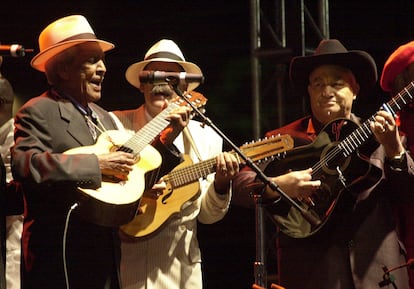
In 1997, the group’s eponymous album was released. A year later, Wim Wenders filmed a documentary by the same name, which traced the lives of the troubadours in Cuba and climaxed with the concert they gave at the end of a tour in New York’s Carnegie Hall. The album sold more than two million copies, and the documentary won the Oscar. But the best part was what happened to the group and its members. Through Buena Vista Social Club, Segundo became active as a musician after 25 years away from the industry. Also making a return was son cubano singer Ibrahim Ferrer, who had sung with Benny Moré and worked as a shoeshiner, and the pianist Rubén González. “Today, to say ‘Buena Vista’ is to say ‘Cuban music,’” says Ochoa. “Because of our project, many others have sprung up that are inspired by us and even have the same name as us.” There’s even been a musical that recently premiered on Broadway, dedicated to the tale of Buena Vista.
After the death of Segundo and Ferrer, Ochoa became a solo artist. Not many people know that he lived for a few years in Gran Canaria and now spends his time between Havana and Madrid, where he has a home near the Las Ventas neighborhood. In Spain, new generations have learned about his work thanks to C. Tangana, who traveled to Havana to meet the master. “I got to the bar before him and I was waiting in a corner. I saw him get out from his car, come in, and look for me among all the people. When he saw me at the very back, he spread his arms and threw himself at me. A nice guy, with talent. We recorded at the same studio where we’d recorded Buena Vista Social Club.”
Ochoa has never been a very political troubadour and usually steers clear of issues affecting Cuba. The interview takes place just one day after the blackout that left the entire island without power. “It breaks my heart to see Cuba in this state. Things haven’t been managed well for a long time. People have lost their joy,” he says. When asked about Donald Trump’s statements claiming that “taking Cuba” would be an “honor”, he laughs and blurts out, “Están en candela,” a Cuban expression meaning things are about to explode. “I was honored by Obama at the White House and thought we were going to do our part to improve the political situation, but no,” he continues. He stares intently at the interviewer and says, “I can only keep playing. That’s what I can do.” As he says goodbye, cutting quite the cowboy figure in his distinctive hat, he grabs his guitar, still resting in its black case on the table. He says, “I am the Eliades that I am. A musician of the people. Nothing more and nothing less.”
Sign up for our weekly newsletter to get more English-language news coverage from EL PAÍS USA Edition