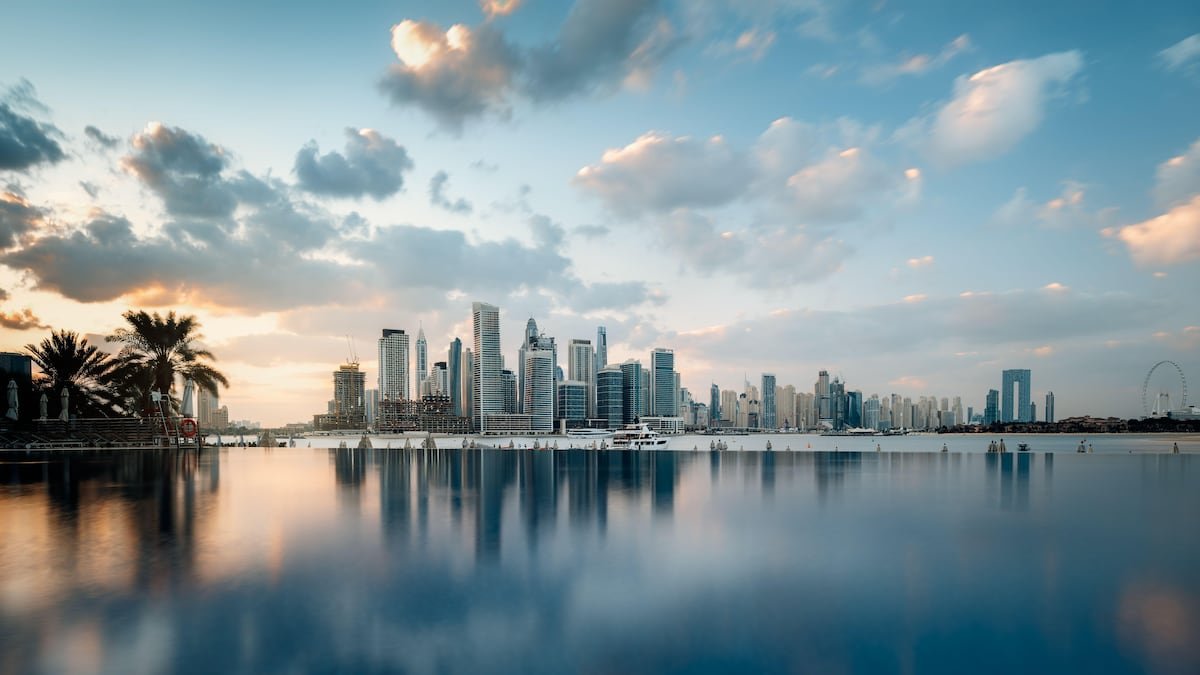
On February 28th, a fragment of an Iranian drone fell on Palm Jumeirah, the artificial island shaped like a giant palm tree in Dubai. And this is so narratively coherent that it seems like something a 1970s science fiction writer would have come up with.
Because Dubai is essentially a dystopia written 50 years ago. Like J.G. Ballard’s Super-Cannes or High-Rise. I read them in the 1990s and thought, “Cool, but it’s impossible that anyone will ever build something like that.” However, not only did they build it, but millions of people have gone there on vacation or to work pretending to be on vacation and posting stories and TikToks.
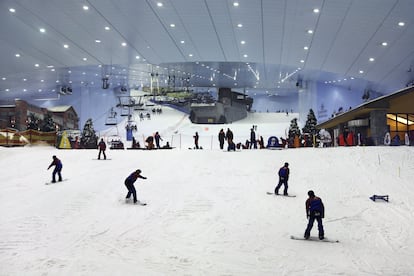
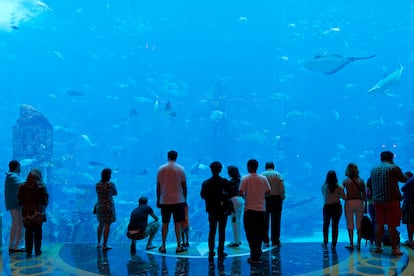
What surprises me is that so many people don’t see it at first glance, because Dubai has never hidden its dystopian nature; in fact, it flaunts it, puts it on display, illuminates it with LEDs, adds an indoor ski slope—Ski Dubai, 22,500 square meters of artificial snow at a constant temperature of -1ºC (30ºF) in a city in the middle of the desert whose drinking water comes from desalinating the Persian Gulf—and charges admission to ski and to see the penguin colony inside. Seriously, there is one. People who, theoretically, should be capable of understanding that a monarchy without freedom of the press, without labor rights, without the right to dissent, with temperatures of 48ºC (118ºF) that require air conditioning in bus stops, represents such an obtuse civilizational model—besides being immoral, but I won’t go into that here—that it comes with its expiration date printed on its forehead. But the hotel has an aquarium in the lobby, and it’s enormous. The suites have windows that look directly onto this aquarium, where sharks literally swim past the glass of your bedroom—all for around €8,000 a night. And this hotel exists: it’s called Atlantis The Palm, and it has 1,544 themed rooms based on the myth of Atlantis at the tip of the palm tree, opened in 2008 with a party that cost £15 million and included a private concert by Kylie Minogue.
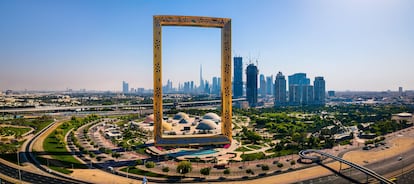
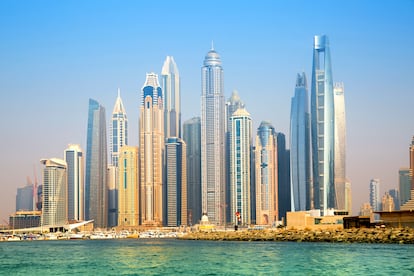
Which brings me to the topic of architecture, which is theoretically what this section of El PAÍS is about, and where the Dubai issue becomes downright parodic. Because Dubai doesn’t have an architectural style; it has all architectural styles at once and none at the same time. The skyline is a catalog of whims on a colossal scale, towers that look like they were designed by eight-year-olds who were told, “Draw the coolest building you can imagine,” and someone, instead of putting the drawing on the fridge door, actually built it. A hotel shaped like a sail—the Burj Al Arab, by Tom Wright for Atkins, 321 meters high on its own artificial island off Jumeirah Beach, opened in 1999, the building that started all this madness. A skyscraper that twists and turns—the Cayan Tower, by Skidmore, Owings & Merrill, 307 meters and 75 floors in Dubai Marina, each floor rotated 1.2 degrees relative to the previous one until completing a 90-degree rotation, finished in 2013. A giant picture frame 150 meters high; yes, literally, a picture frame, planted in the middle of the city—the Dubai Frame, in Zabeel Park, inaugurated in 2018, whose own architect, the Mexican Fernando Donis, denounced that his design had been stolen and publicly described it as a “postmodern pastiche” of his original idea, which, if you think about it, is the perfect metaphor for what Dubai does to everything it touches. And below, nestled in the fronds of the artificial palm, are the villas, another category of delirium—mansions of 2,000 square meters, which are actually the modest ones, because those custom-built at the tips of the fronds reach 4,500, with garages for 15 cars, their own hair salon, private cinema, bowling alley and infinity pool; the most expensive one ever sold had 18 bathrooms, which is more different bathrooms than most people will visit in a month or in 12 months—and architectural styles to choose from: Mediterranean, Ottoman, Balinese, contemporary minimalist, or whatever the buyer happened to see on Instagram that week. Tuscan marble, French oak, decorative Arabic latticework that doesn’t ventilate at all because the entire building is climate-controlled at a permanent 21ºC (69ºF). It’s pastiche elevated to urban planning doctrine, a Las Vegas without the alibi of irony.
Jean Baudrillard would have wept with joy, or horror, or probably both. Because Dubai is the ultimate realization of the simulacrum, the place where the copy has so completely replaced the original that the question no longer even makes sense. There is no local architectural tradition being poorly imitated, no reference point being degraded. The reference point has disappeared. What remains is an entire city built from renders, from promotional images that became physical reality without passing through any intermediate filter of history, context, or necessity. Dubai is a habitable render. The map that preceded the territory.
But that’s not the worst part; the worst part is who built it. Who really did. Because Dubai is a city that tells you, “Look, we have slave labor with a sea view,” and people would reply, “That’s crazy…so how much is Friday brunch?” A city where 90% of the population is foreign and 90% of the workforce is too, but they’re not the same kind of foreigners. Where there is an island whose palm-like shape is only visible from the air or from Google Earth—that is, whose architectural grace was designed to be consumed as an image rather than as a space—and which was built by Nepalese, Indian, Bangladeshi, Pakistani, Filipino, Ethiopian, Ugandan, and/or Kenyan workers whose passports were confiscated, so that later a British, American, German, or Spanish influencer could film themselves in a swimsuit saying “living my best life.” The narrative arc is there, in plain sight, without the need for metaphor because reality itself was the metaphor.
And now a fragment of an Iranian drone has pierced the bubble, both the real and the metaphorical one. Perhaps the yogurt was already expired and the dystopia is simply fulfilling its own script.
Sign up for our weekly newsletter to get more English-language news coverage from EL PAÍS USA Edition